Spring arrived more than a month ago and with it came 80 degree days, prompting the magnolias and spring bulbs to respond with blossoms as much as six weeks earlier than usual.
While I don't deny that we have enjoyed the beauty of the blooms, it hasn't been without its pitfalls as well, particularly with the magnolias.
Usually, the star magnolia blooms first among our flowering trees but this year, the saucer magnolia was covered in plump mauve buds a full week ahead of the star.
During the last week of March, just as the saucer blossoms were starting to open, a couple of seasonably cold nights turned the pearlescent blooms to a gloomy brown.
Within a week, it was clear that the saucer bloom was a near total loss. An occasional bud has opened since, but almost all have shown signs of cold injury. Today, a single bud shows some of the glory we missed earlier in the season.
In the meantime, the star magnolia has regaled us with three weeks of glorious blossoms and just as the blooms are beginning to fade, the yellow magnolias, "Elizabeth" has erupted with a gorgeous display of crisp yellow blossoms.
 |
| The saucer magnolia would have been magnificent if had only bloomed a week later, after the last frost. |
 |
| The star magnolia has been the star of the woodland grove for three weeks. |
|
|
|
|
|
|
 |
| The star magnolia in full bloom. |
 |
| The yellow magnolia, "Elizabeth", is covered with butter yellow blooms, almost a full month ahead of last year. |
 |
| The yellow blossoms cover each branch like translucent origami birds. "Elizabeth" is a pale buttery color, while "Yellow Bird" is a much darker, brighter yellow. |
We've enjoyed the smiling faces of the pansies and daffodils for several weeks. While the pansies will continue to bloom through the early summer, the daffodils are already beginning to fade.
 |
| This year, with temperatures soaring past the 80 degree F mark in early March, we planted the pansies in pots in case a surprise snow storm were to head our way. Spring snows are not uncommon, and pots are easily brought into the garage. However, the weather has continued to be mild and the pansies are thriving. |
 |
| Our latest decorative addition, this princely frog added another rose to our collection |
When we originally planted the daffodils in the fall of 2006, we planted them, along with tulips, in clumps of 25-50 to achieve maximum impact from massed blooms. The first spring, the effect was stunning. We had early, middle and late spring blooming varieties in large clumps of every shade of pink, magenta, white, purple, and rose (tulips) and daffodils with single and double trumpets and petals and trumpets in white, yellow, orange, apricot, and pink.
Since then, few clumps remain as the voles have gradually decimated them over the course of several winters. We will replant this fall, but I fear that this is going to have to be a regular part of our fall garden maintenance in order to be able to enjoy the spring beauty of these gorgeous blooms.
 |
| All of the large clumps of daffodils and tulips in the perennial beds have been reduced to a handful of blooms each. In the front, we still have a few clumps such as these, but even these are markedly reduced in size compared to previous years. We will replant, but controlling the vole population is a top priority for us this gardening season. |
 |
| Although the daffodils come in a wide range of colors now thanks to hybridization, my favorites have always been the pure white ones. |
 |
| On the bottom left is one of our few remaining miniature daffodils. Five years ago, we had several hundred that bloomed with miniature iris. This year, the miniature iris bloomed more than a month early, upsetting the carefully planned palette we had laid out for spring color. |
The fruit trees are all in bloom and we are continuing to observe some strange happenings in the old apple tree in front. This tree was already fully grown, mature, and neglected when Steve purchased the house in 2001. We aren't sure exactly when it was planted, but the house is over 30 years old. It got its first serious pruning in 2002 and since then, we have carefully clipped away suckers.
We never noticed anything unusual until two years ago when we had a profound drought. At that time, we noticed a significant size difference in the fruit; the apples on the left side of the tree were smaller than usual, but still at least 2.5 inches in diameter while the apples on the right side of the tree were the size of large cherries. Last summer, a similar drought that lasted through late July and much of August produced the same result.
This spring, we were surprised when blossoms on the right side of the tree appeared not only weeks earlier than usual, but much earlier than any blooms on the left.
We've looked at the tree carefully and unlike a tree demonstrating a similar finding in our back garden, we can not find an obvious graft site, but clearly, we have a tree that bears two distinct kinds of apples.
 |
| Apple blossoms on the right side of our full sized apple tree in the front yard. |
 |
| The cherry tree, a vision in white. |
 |
| Cherry blossoms and new leaves cover all of the branches and twigs. |
 |
| The sand cherry that we thought might not survive last year has responded well to our hard pruning and splinting of it's shattered trunk. The yard is perfumed by the gorgeous blooms which cover every branch. |
 |
| The sand cherry blossoms are a visual and olfactory delight. |
Our three weeping cherries each have slightly different blossoms. One has pink buds but white blossoms, and of the two with pink blossoms, one has deeply ruffled, very heavily triple-petaled blooms, while the other has a double row of slightly deeper pink petals with the center of the blossom clearly visible.
Interestingly, although they bloom profusely, none of the three weeping cherries produce any fruit. However, since we planted them, the taller, mature cherry (white blooms), which previously bloomed but produced no fruit at all, has produced large amounts of fruit for the past three years. The squirrels and birds eat the fruit in the fall even though it never completely ripens, likely due to a growing season that isn't quite long enough for this unknown variety.
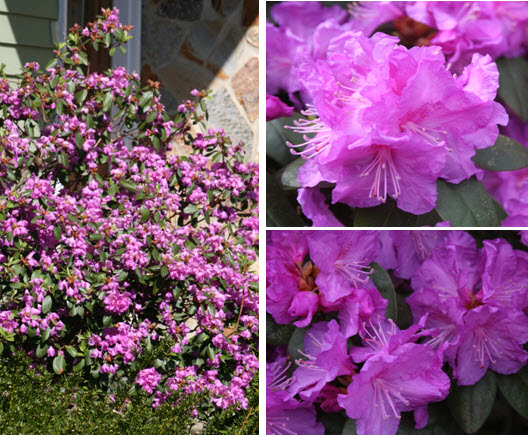
Our earliest blooming azalea, this unidentified variety, has blooms with both single and double ruffled petals and prominent stamen and anthers. I am surprised that the honey bees which have been visiting the other spring blossoms have not been visiting this particular shrub.
Below, photos of two of our three Cleveland pears. All three of the trees are beginning to fill out and are covered with delicate white blossoms.
Two other very early bloomers this year are (left) one of our Canadian hybrids and (right) the common lilacs. Usually, we don't see lilac blooms until Mother's Day, but this year, unless one of our later blooming varieties blooms according to it's own time frame, my guess is that most of our shrubs will have completed their bloom cycle by early May.
The flowering quince is another shrub that bloomed more than a month early and like the magnolia, suffered the effects of cold weather in its blossoms. The shrub has attracted many bees but I was hard pressed to find many blossoms that didn't have tell-tale browned edges that are the result of a couple of very cold nights at the end of March. It will be interesting to see in the fall if the crop of fruit is affected.
The Santa Rosa Plum has also thrived over the past year and the tree has increased in height by more than a foot and has also filled out at least twice it's width over this time last spring. Each branch and twig is covered with blooms but this is another tree that the bees have not seemed to favor, both last year and this one as well. Last year we had a very scarce crop of plums; I wondered then if that was due to immaturity or a lack of pollination. We'll see what this summer brings.
Other spring-blooming bulbs include our hyacinths and grape hyacinths, all of which are blooming equally early. The color display has been magnificent this year; this seems to be one bulb that the voles avoid, and definitely one we want to plant more of.
 |
| A magenta striped hyacinth and a wild hyacinth add pops of color in the perennial beds. |
 |
| We have numerous blue, purple and white hyacinths, Hyacinthus orientalis, which seem to have survived and thrived despite the voles, which have decimated our daffodils and tulips. |
 |
| Grape Hyacinths, Muscari racemosum. Ours are all the common variety, shades of deep blue and purple. |
Last year our previously gorgeous display of creeping phlox was nearly destroyed by a careless plow driver who skimmed the top of the cottage bed and cleaved our sand cherry tree in half.
We planted some pots of phlox in an attempt to repair the damage, but probably due, in part, to a very dry summer, and as well in part to competition from wood violets, they did not thrive the way I had hoped.
These are three of the original plants that we were able to salvage and nurse back to health, and which are blooming robustly this spring. Most of the plants we added last spring are struggling and have a rare blossom if they are blooming at all.
We replanted again, early this spring, and while the blooms are once again lovely, we can only hope that these plants will fare better than their predecessors.
 |
| The newer plants are in brighter colors than we previously had growing along the edge of the bed. |
Blue is a prominent color in the our spring gardens. Everywhere you look, bright white, soft yellow, and brilliant pink blossoms burst against a sea of blue.
A pleasant surprise was this lovely blue primrose which is blooming near the front stairs. It was labeled as an annual but I've had them overwinter before and was delighted to find this one blooming this week.
 |
| Primula vulgaris |
The violets are another very early bloomer and among my favorite wildflowers Wood violets have gotten a bit too dense in some of our cottage beds and we are moving many clumps of them to the dry river bank that borders our tree grove. A single white violet lined with blue found its way into the herb bed and I'm hoping it will self sow and spread in that area. And the Labrador violets are popping up everywhere, another group that we are relocating to the wood grove and dry river bed.
 |
Viola labradorica
|
 |
| Clustered under the shrubs in the fairy garden, in another month they will form a dense carpet that will bloom all summer. |
 |
| A single white violet is a pleasant surprise this spring. It appeared in the herb garden, probably after seeds blew in from the neighboring meadow. |
 |
| I adore wood violets, so much so that the clumps that are threatening to overtake the cottage garden are being moved into other areas where they can spread at will. |
|
|
Veronica (Speedwell) makes an excellent ground cover in cottage beds. We've found that it thrives in both sun and shade and it blends well with other ground covers such as violets and forget me nots.
 |
| Veronica "Georgia Blue" |
|
 |
| Veronica "Georgia Blue" with blue and white forget-me-nots (Myosotis sp.) |
|
|
|
|
|
|
|
|
Other early bloomers in the cottage garden are the hellebores, bleeding hearts, candytuft, and columbine.
 |
| Hellebores in multiple shades of white, lime green, rose and burgundy have been blooming for over a month. |
 |
| Both the large red and white Bleeding Hearts (Dicentra) are in bloom now. |
 |
| Showy mounds of Iberis semperivens, candytuft, are also growing along the borders of the cottage gardens where they contrast beautifully with the creeping phlox and columbine. |
 |
| Low growing varieties of columbine are in full bloom while the taller varieties are fully budded, more than a month ahead of last spring. The columbine has proven itself a hardy, colorful, and ever changing addition to the cottage gardens. Cross pollination has led to a new and sometimes surprising color each spring. |
We opened the water garden nearly a month earlier than usual this year. Ordinarily, we restart the waterfall and black light (which provides ozone to disinfect the water) in early May when the temperature in the water is about 50 degrees. The warmer than usual spring temperatures raised the temperature of the water in the pond and the koi had been actively schooling. With the bog plants also showing exuberant spring growth, it was time to clean the pond and prune and feed the bog plants as well.
 |
Top Left: The Koi have been schooling and swimming briskly. Top Right: Marsh Marigolds (Caltha palustris) have been blooming for two weeks. Bottom: Siberian Iris (Iris sibirica) and water mint (Mentha aquatica) show early, prolific growth.
|
Throughout the woodland garden and our many shade and sunny cottage beds, we are seeing early blooms and accelerated growth of plants we don't ordinarily enjoy until mid to late May.
 |
Rock Cress, Arabis caucasica
|
 |
| Brunnera macrophylla, "Jack Frost" |
 |
| Armeria maritima, thrift, or sea pinks |
 |
| Another early surprise in the woodland garden are the trillium which appeared to sprout and blossom almost over night. |
As I've prepared this post, the lilacs have erupted in full bloom and the mid spring tulips have also blossomed. Every day there is a colorful new surprise. Each month, you can enjoy blooms from gardens all over the world who participate in the monthly
Garden Bloggers; Bloom Day. Hosted by fellow Blotanist Carol of Indiana, you can find links to visit all of the gardens that participate in this monthly bloomfest on her blog at
May Dreams Gardens.