Showing posts with label Neptune. Show all posts

Monday, October 26, 2015

Beautiful Roses... Patio Perfection

Potted annuals on the table on the patio.
Our patio garden is thriving.  We have pots and pots of annuals -- I just replanted the window boxes with chrysanthemums and pansies in and amongst the calibrachoa and coleus which continue to thrive.

Our Meyer lemon tree will have a generous crop of lemons for us in another month or two and around the bottom of the lemon tree, spearmint is growing enthusiastically and will be a welcome addition to tabbouleh salad over the winter.

The mauve blend floribunda Koko Loco.
We continue to harvest thyme and oregano but I've fought a losing battle with the slugs over the basil.  And our succulents are doing equally well.  In fact, they've grown so much, they need to be repotted again.

But the stars of the patio are, without a doubt, the roses.  Neptune and Strawberry Hill just finished a bloom cycle; Neptune has a single bud remaining after a beautiful display of deep mauve-purple  blossoms. But Koko Loco and Sugar Moon picked up where the others have left off.

Koko Loco is a mauve blend floribunda bred by Christian Bedard in 2010 and introduced in the US in 2012 by Weeks Roses. We bought it for our garden in Newburyport as soon as it was available and I had it growing with Hot Cocoa where the pair made a fabulous combination.

Bud, barely opened, of Koko Loco
Here in California, the roses are much more enthusiastic growers and bloomers than the same roses grown in New England, with its much shorter growing season and variable weather. 

Here, we can really appreciate the color changes in Koko Loco. Considered a "mauve blend", the buds have a dark peachy color, open up as a buff that is close to the color of creamy hot chocolate, and gradually evolve to a true mauve. Having all of the different colorations present in different blooms at the same time on the shrub is a treat! 


It's coloration reminds me a lot of Bella'roma, a hybrid tea bred by Dr. Keith Zary in 2003. It was one of the first roses we planted in our garden in Newburyport and was one of my long time favorites, not just for its color but for its wonderful fragrance. Bella'roma is a peach-yellow blend, but in our New England garden, the colors were more subtle and before it turned brighter yellow, it was the same buff colored tinged in peach that I love in the Koko Loco.


The hybrid tea, Sugar Moon, crisp white and wonderfully fragrant.
The white bloom, one of the purest white roses we have ever grown, is Sugar Moon, another wonderful hybrid tea hybridized by Christian Bedard (2012). I was attracted to Sugar Moon not only because of the large blossoms and bright white coloring but because of the fragrance - a perfect blend of citrus and rose.

Although not as prolific a bloomer as the floribunda Koko Loco, the blooms are amazing and the rose usually has at least one blossom open and perfuming the patio at any given time. It's a wonderful cut rose for the vase as well, and I frequently clip buds to finish opening indoors.

Koko Loco,showing hints of peach and mauve.
The opening blossom of Koko Loco shows more of its peachy tones.
Koco Loco, bloom gradually shifts from peach to mauve
Early bloom is more peach in color.
Side of our patio, the coleus have thrived!

Front of our patio, with newly replanted window boxes; the snapdragon we planted in spring is still blooming vigorously.  In the background, the Meyer lemon displays fruit from several bloom periods.
Some of the smallest baby lemons from the last bloom a few weeks ago.
One of the earliest lemons is started to ripen but it will be weeks yet before it's ready to be picked.
This morning I discovered new buds - meaning yet another crop of lemons.  With at least four different crops from four different blossoming times, we should have fresh lemons over the winter and into the spring.
These were from the second crop and won't ripen for at least a couple of months.
This bud of Neptune will be open in the next day or so.  While the buds are a deep rosy mauve, the mature blooms are a lavender mauve and the roses has the strong citrus notes in the fragrance that I've come to associate with lavender roses.

Monday, August 31, 2015

Elusive Neptune

Neptune, the eighth and farthest planet from the sun passes closest to the Earth today in its orbit around the Sun.  The third largest planet, Neptune is unique among planets in that it's the only planet that can never be seen with an unaided eye.

Position of Neptune in Aquarius.  Credit:  Astronomy.com
While the other planets may appear as dim to bright spots among the stars, coasting along so deep into the far reaches of the Solar System, even when its orbit brings it to its closest point to Earth, Neptune is still only visible as a dim speck, even with the help of binoculars or a telescope.  And even then, it can be elusive.  It is so much dimmer than the dimmest stars in the sky, it's often only spotted if one is fortunate to have a an area free of sky pollution in which to sky watch and is familiar enough with the stars in the surrounding area to recognize it.

Over the next couple of days, our planet Earth's orbit will pass directly between Neptune and the Sun.  Looking at the three on edge, they will appear with their equators in line across the Solar System.  This alignment is referred to as opposition – opposite the sun in Earth’s sky - that planet is the closest it will be to the Earth for the year. Typically, the planet will shine brightly and be easy to

Locating Neptune in Aquarius       Credit: EarthSky.com

Neptune's opposition will occur on September 1st and on that night, the planet will rise in the east around sunset, climb to its peak in the sky by midnight, and then set in the west around sunrise.

The best way to locate Neptune is to first find the constellation Aquarius (The Water Carrier).  Spatially speaking, it's closer than the constellation and should appear in front of it.  Then you need to consult a detailed Star Cart so that you know all of the stars that are ordinarily visible in that area. Then look for that dimmest of specks that doesn't belong. 


 Facts About Neptune:

A Neptonian Day is about 18 hours, with the ice giant spinning like a dervish on its axis.
By contrast, it's year - the time to orbit the Sun - is roughly 165 Earth years.
It's the stormiest planet with wind speeds that break the sound barrier.
Eventually, it's strong gravitational pull will destroy its moon, Triton.
It appears as a
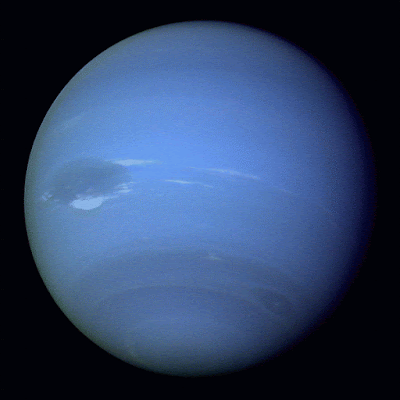
Neptune as photographed by Voyager 2       Credit: EarthSky.com
In 1989, the Voyager 2 spacecraft flew past Neptune and sent back the first close-up images of the planet and its moons, now numbering a total of nineteen.  It's the only spacecraft to ever have visited the planet.  Additional images of Neptune have been provided by the Hubble Space Telescope and some of the larger ground-based telescopes.

The Voyager 2 flyby revealed Neptune appearing as a bright, azure blue planet with a deep blue spot not unlike Jupiter's red spot.  The blue color is due to the presence of methane in its outer atmosphere.  Planetary "color" is a function of reflected light from the Sun.  When the Sun's light hits the atmosphere, the methane absorbs the light in the red spectrum and reflects back the blue light, giving the planet the appearance of a bright blue orb. 

References:

EarthSky     http://earthsky.org/tonight/neptune-comes-closest-to-earth-for-the-year-on-august-31
Wikipedia    https://en.wikipedia.org/wiki/Neptune
Space Facts    http://space-facts.com/neptune
Universe Today    http://www.universetoday.com/21591/color-of-neptune/

Astronomy   http://www.astronomy.com/observing/sky-this-week/2015/08/august-28september-6-2015