Thursday, June 9, 2011

A Celebration of Roses: "Rose Night" at the BBG

Rose Night at the Cranford Rose Garden is an annual event at the beginning of June that celebrates the garden when the roses are at their peak in blooms. The event is a soiree to which members are encouraged to wear period hats, bring a picnic, and dance the evening away in an atmosphere that harkens back to the early days of the garden.

After staking their claims - laying out their picnic blankets or setting out their dinner on one of the tables set along the mall next to the garden, attendees had an opportunity to wander through the gardens and enjoy the spectacular display of roses with the gardens at their seasonal peak.

A group performed lively music for dancing and entertainment.


Steve was unable to attend due to a prior commitment but encouraged me to go. Traveling alone is scary enough for me, but to New York City no less! Add a disability, a wheelchair, and a host of other complicating conditions and well, only someone who really loves roses would deign to attempt it. So, of course I went.

Afraid to tackle this adventure alone, we invited a close family friend, my adopted "Mum" Joan, to go along.

She was the perfect choice, as we both have a "thing" for period hats, vintage anything, and getting "gussied up".

We arrived early enough at the event to claim a comfortable bench next to the Rose Arc Pool where we could feast on our picnic, enjoy the music, and watch the activity.


Fewer guests "dressed the part" than we'd expected, but we didn't feel out of place at all. In fact,  we received several compliments on our hats and soiree attire.

Ironically, they weren't the hats we'd planned to wear (those had been accidentally left behind). Determined to wear "fancy hats", guided by the helpful staff at our hotel, we navigated the NY subway system in search of a mall. Our hats for the evening were last minute purchases we'd been able to scavenge that morning.  Still, we were dressed to the nines and loved every minute of the festivities. 

Joan's hat was a black straw hat that matched her dress perfectly. Her dress was an organza with a handkerchief hem and was adorned with beaded and embroidered roses.

My hat had a wired ribbon ruffle and feathers clustered in the back. I dressed it up even more with a black and white ruffled scarf that circled the brim and cascaded down my back. My black skirt hung in gathered scallops and I had a simple white shell with a ruffle falling from the  neck. We'd each brought fancy shawls in case the temperature was cool, but the night was perfect and we didn't need them.

We enjoyed watching the families who were picnicking with their children, often with grandparents or other extended family members and friends as well.  It was especially nice to see kids running through the area, laughing and playing, and families establishing traditions around this event.

The Cranford Rose Garden opened in 1928 and is a highly regarded collection of both old world "antique" or "heirloom" roses, species roses, and more modern varieties.  Roses of every class and color cascade over trellises and pillars and fill an immense series of beds. According to the web site, the garden still contains some of the original roses that were planted in 1927.

 
The garden is a living memorial to Walter V. Cranford, the subway engineer and garden philanthropist who funded the entire cost of the initial construction.  The original garden was designed by Harold A. Caparn. A pioneer in landscape architecture who taught the first formal course ever offered in landscape architecture at Columbia University, his work as the consulting landscape architect for the Brooklyn Botanical Garden is considered his greatest professional achievement. He was assisted in this project by Montague Free, the garden's horticulturist at the time.

We thoroughly enjoyed the evening as well as yet another opportunity to wander through the fragrant roses, and I hope to begin an annual tradition of our own, attending this fun event.

Along the walkway facing the "rose hill". The pale almost peachypink colored rose in the middle is Abraham Darby, a David Austin English shrub rose. The roses on the hill are bordered by catmint, an herb that we also pair with roses in our own garden at home.
I don't know the name of this rose, but it was quite a beauty so I snapped a picture of it just the same! (I could not find rose tags for some of the roses.)
This is one of two very old, very gnarled weeping cherries that anchor the farthest corners of the mall next to the rose garden, where the event was held.
Picnickers toted coolers ranging from small totes to large, wheeled ice chests. We saw everything from sushi to fried chicken, sandwiches and salads.
There were tables dressed with red tablecloths and white chairs, but many people brought blankets and picnic baskets as well.  We arrived at about 5:45 PM and over the course of the next 45 minutes, the mall gradually filled with members.
The Rose Arc Pool is a truly lovely area to wander and meditate.
The unidentified yellow rose toward the back on the right is along the far side of the walkway behind the border of red roses, and has a truly magnificent fragrance. The roses massed in front along the edge of the pool are Knock Outs.
The Chevy Chase Rambler was covered with blossoms. A spring flowering non-repeat bloomer, I was happy to be able to be here when it was in full bloom
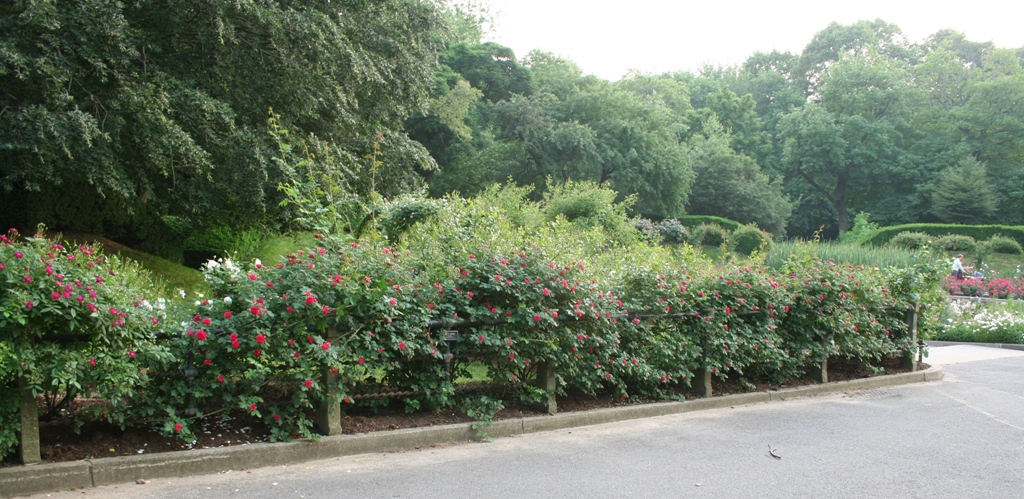
The Chevy Chase rambler covers much of the fence along the lane that leads to the Rose Arc Pool and the rose garden proper.  Cecile Brunner is prominently featured along the fence that continues on the far side of the Pool up to the main gate of the rose garden.


The profusion of scarlet blossoms were not as fragrant as I'd hoped they'd be, probably because it was so late in the day and the weather had been so very hot and humid. But there was not mistaking the sweet, tea rose fragrance.
I'm unsure of the cultivar but this perfect peach colored blossom has a wonderful fragrance.


Tucked into the farthest corner of the long trellis, the Mary Lovett is a pure white Hybrid Wichurana, a large-flowered climber.  The photographs simply don't do it justice.
A perfect Mary Lovett bloom poking from the back side of the trellis. Unfortunately, I could not get close enough to enjoy the lovely fragrance of this bloom.
The gated entrance to the main garden. Catmint fronts the climbing roses that adorn the trellised walls.
A hint of the breathtaking beauty that lies beyond the trellised pavilion that spans the garden.
A Victorian style latticed pavilion stretches across the garden, with pergolas on either side extending over the walking paths and providing support for some beautiful climbers.

This John Cabot is a stunning feast for the eyes. Though the fragrance was very mild, it was sweet and lovely just the same.
The pavilion forms a lovely backdrop for a bronze statue of a young woman with roses cascading over her shoulder and a sundial in her hand, set in a circular rose bed.

Wednesday, June 8, 2011

A Star of the Garden: A Lovely Yellow Peony

When our yellow peony blooms each spring, no matter the weather, it's always a sunny day.

An unusual color for a peony, Singing in the Rain graces our garden with a gorgeous display of blossoms that move through a range of colors.  Dark pink buds open into warm peach semi-double flowers reminiscent of tree peony blooms. When they first open, the blossoms are heavily tinged with a rosy apricot color that gradually fades over time to yellow as the blooms mature. Once fully mature, the butter yellow petals have an occasional dark pink streak.

With new rose-tinged blossoms opening among older yellow blossoms, the shrub, which grows as a perfect mound, is covered with a rainbow of colors ranging from papaya to banana against a backdrop of dark green foliage.    The word "stunning" hardly does it justice.

I acquired this beautiful yellow bloomer as an anniversary gift for my husband several years ago.  While I prefer rose, burgundy, lavender, and magenta hues, Steve loves autumn colors -  yellow, rust and orange flowers.   When I initially designed the garden, I didn't include any yellow or orange bloomers in the design plan.  As we added new plants and shrubs, Steve would point to a brilliant orange or lemon yellow bloom but I resisted  mixing yellow and orange with my mostly pink, rose, purple, white, magenta, and lavender palette.

Then, while I struggled through a very difficult chemotherapy protocol, my wonderful husband took over the lion's share of the garden maintenance.  He single-handedly cared for all of my "pink" flowers without complaint and especially without pointing out that none of his favorite colors were included.  When I was finally back on my feet, not only did I begin to introduce yellow and peach into the rest of the garden, but I also built a mostly orange and yellow bed just for him.  The bed gradually took shape over two summers and this shrub is the crowning glory.  Positioned next to the head of the stone walking path that meanders along the entire length of the bed, it anchors the bed.  Along with the yellow trumpet vine that cascades over a pyramid trellis behind it, it serves as a border between the yellow garden and the herb garden.

According to Select Plus Lilacs, where I purchased our shrub,  the name Singing in the Rain  reflects the way that the blossoms stand up to and are completely unaffected by the rain.   We can attest to that.  Unlike our herbacious peonies, the flowers are held up on very sturdy stems and never droop, even when the blooms are heavy with water from a driving rain.  Another advantage to these gorgeous blooms is that since they are sterile, they do not attract ants.  I can cut a few stems for a vase on the table without having to worry about tiny ants hiding in the crevices between the petals.

Like our tree peonies, this peony also blesses us with a bloom season spanning several weeks.  Initially covered with blossoms from the terminal buds, there are many side buds on each branch that will mature and bloom over the succeeding days and weeks.

Unlike what we experience with our herbaceous peonies, we see virtually no loss of the side buds. Once the terminal bud finishes blooming, virtually every side bud matures and blossoms in another wave of blossoms that are just as beautiful and as large and as sturdily held as the first ones. 

These "intersectional" peonies are a cross between a tree and an herbaceous peony, with some characteristics of each.  While they remain the size of a large herbaceous peony, the structure, especially of the base and main trunk area, is more like that of our tree peonies.   I have learned from experience to treat them more like tree peonies when it comes to feeding, pruning, and winter protection.

hen I drastically pruned another Itoh at the end of the season way that we cut back our herbaceous peonies, the short stems did not survive the winter and the base of the shrub could not sustain new growth.  Now, I deadhead the spent blossoms as they fade in spring and prune off  damaged leaves in the fall, but we don't do any drastic pruning and no cutting back in the fall (as we do with the "regular" herbaceous peonies).  I find it much better for the shrub if I wait until the new eyes sprout from the shrubby base in spring.  After the new eyes sprout and begin to grow, I carefully cut back the deadwood from the previous year.  A very sharp pair of rose pruners does this quite nicely.

Blossoms open with a rosy peach hue....
... and gradually become more yellow as they mature.
A mature yellow blossom with a dark pink streak

Mature blossom, pale bright yellow, with rose streaks.
Taken two days after the above photograph, you can see the color change as the blossoms gradually open.

This lovely peony is available from Select Plus Lilacs. You can check their web site or email them for ordering and delivery times.

Tuesday, June 7, 2011

Our Baby Robins Take Flight!

Yesterday, when I looked in on our little robins early in the morning, Mother Robin was perched on the edge of the nest, while the two fledglings, who have doubled in size and are now sporting a full coat of feathers, peeped loudly at her.

Unwilling to disturb them for a photograph, I decided to wait, hoping that Mother would fly off in search of food and I could get perhaps one last photograph of the peepers cuddled together in the nest. I knew she would soon be rousting them from their home and I was hoping I would get to see the little ones take their first flight.

Alas, I missed the main event. A short while later, I heard peeping and fluttering in our crab apple and the Japanese maple, and mother and babes were fluttering about. Getting a picture of them has not been easy as they are flitting from branch to branch in the tree grove. But I did catch one of the little ones in flight as it followed mother to where she was loudly chirping in one of the tall pines.

This morning, they are still sticking close to the trees in the yard, the fledglings flitting in and out of the maple, the variegated willow, the crab apples, and the pine, with all three, mother and her two offspring, chasing one another while keeping up a lively chirping, and still hard to catch on camera.

Although I'm sad I didn't get to see them actually leave the nest, we all are delighted that we were able to host the little family these last few weeks. But I must confess, it's nice to finally be able to reclaim our patio and the sliders from the family room to the back gardens!

The "Comeback Kids": Dwarf Cherry Laurel

This spring, our Dwarf Cherry Laurel (Prunus laurocerasus), Otto Luyken, bloomed for the very first time. This might not seem at all special to most gardeners, but the history of these plants makes this a rather impressive event. Just a few years ago, they were sitting on a dusty shelf at the local Home Depot, about to be tossed into the dumpster.  I couldn't be happier that they have made quite the comeback.

Often called English Laurel or Common Laurel, we bought the plants near the end of the growing season five years ago.  When we got them, they were undersized, pathetic-looking potted shrubs that were dwarfed by the one gallon containers they were potted in.  We spotted them sitting on a shelf marked down for quick sale with other equally sad looking perennials. They appeared sorely neglected and many of the leaves were yellowed and spotted, probably with some sort of fungus.

Now ordinarily, I never buy a plant that doesn't already have a designated home in our garden and I am very particular about buying plants that even hint that they might be infected. And I wasn't even looking for Cherry Laurel. I had been looking for mountain laurel shrubs for two years, but both nurseries who usually carry it around here had sold out of it very quickly and had already been out of it when we went to purchase it early in the season two years running. 

The bed we were looking to plant mountain laurel in was a new bed along the back of the gazebo that was mostly shady. I'd placed some dwarf fringed dicentras and some columbine there, but I was looking for mountain laurel to really anchor the bed and I wanted to buy four of them. The only thing these plants had going for them was that there were four of them and we had four spots to fill.  We bought them. 

From our almost weekly trips there for manure, topsoil, peat, pots, bricks, garden tools, trellises, and plants, we'd gotten to know the Plant Department manager who worked there at the time fairly well. I commented to her that they were the saddest looking plants I'd seen in a long time and they looked like they needed some love. She said they were headed for the trash. When I told my husband we should buy them because no one else would, he did the eye roll thing but he didn't say the magic words: "No way."  The plants on the shelf were marked down to $5. She said we could have them all (there were four of them) for $5 - they were literally about to be thrown out. When we paid for them, I think the clerk thought we were as good as throwing our five dollars away. I know I did.

When we arrived home, I segregated them out front, pruned the skanky leaves, and fed and watered them. I sprayed them with my usual garden spray mixture but went a little heavy on the soap and oil.  Ordinarily, given their condition, I would have wanted to isolate them from the rest of the garden until they started to show some new, healthy growth and appeared disease free (or cured). But since it was already closing in on the end of September, I needed to get them into the ground so they could establish a root system before the ground froze. As soon as I got them "cleaned up", into the ground they went. 

At the time, I knew nothing about Dwarf Cherry Laurel. The care and planting labels that are usually on the pots were long gone and the plant tags gave little information other than the plant cultivar name.  But I knew about mountain laurel, so assuming they couldn't be much different (and we all know what the meaning of the word assume is...), these four little scraggly shrubs, which I later came to learn ordinarily like full sun to part shade, ended up in a very shady garden, where, unbelievably, they have thrived.

Dwarf Cherry Laurel is ordinarily a slow to medium growing plant that needs minimal care but does require a fair amount of sun. Because they are in a garden bed that is generally out of sight (and out of mind), except for the usual spraying and feeding that the entire garden gets, they have experienced a fair amount of benign neglect since we planted them. I do make the rounds of the garden regularly with Steve, and many times, the thought, "What was I thinking?" has popped into my head. 

This year the plants have reached a height of about 18 inches high and just a bit wider, triple the size they were when I planted them. They are planted in a rich humusy soil, but I suspect the lack of full sun has slowed their growth rate even more than what is normal for them.

When I saw the flower spikes this spring, I was amazed. When the blossoms opened, I was pretty impressed with the fragrance. Although the tiny blooms faded within a week (and that could have been weather related), it was a delight to see them bloom nonetheless.


Sunday, June 5, 2011

Wine and Roses: Pairing Fragrance and Flavor

Of all the rose collections we have toured over the years, the Cranford Rose Garden at the Brooklyn Botanical Garden remains our favorite place to experience roses on a grand scale. 

Their collection of 5,000 roses representing close to 1,500 varieties is large enough to overwhelm the senses yet the lay-out is intimate enough to be able to enjoy and appreciate the beauty in not only the individual roses themselves but also the way the collection is organized and laid out.


This past week, at an event hosted by Sarah Owens, rosarian and rose curator at the Cranford, I savored the fragrance of roses and the flavor of wine in a way that was quite unlike anything I've ever experienced before.

Flavor and fragrance are related in a complex partnership -- the senses of taste and smell are locked together in our brains as two key elements in experiencing flavor.  They are neurologically distinct yet curiously interdependent; it's difficult to experience one without the other. Think back to your last nasty head cold with a stuffy nose; you'll probably recall that things didn't have much taste either.

In an evening lecture that combined a walk through the rose garden with wine tasting, Ms. Owens challenged the attendees to concentrate on the fragrance and to try to discern the different fragrance notes in the perfume of a given rose, and then to likewise focus on the experience of taste and in so doing, try to identify distinct flavor notes in the wines she chose for us to try.

As we walked through the garden, we came upon small linen draped tables set with bottles of wine and wine glasses, each having been placed next to a specific rose.

Ms. Owens provided lively, interesting commentary on the history and characteristics of the roses she had chosen to feature, the origin and background of each of the wines she had paired with each rose, and then guided us to use our senses to identify the specific fragrance and flavor notes she spotlighted at each stop along the way.   It was a feast for the senses.

Sampling table next to Abraham Darby

The pairing I enjoyed the most was the first one she demonstrated: a climbing Cecile Brunner, one of my favorite antique roses, and Moscato d'Asti wine. She has made me a Moscato fan for life.


It's small wonder this one drew me in right out of the gate. I have always been particularly fond of the musky, fruity fragrance of Cecile Brunner, a delicate departure from the more modern "rose" fragrance, with a mossy note underlying it all.

And Moscato d'Asti is a fruity dessert wine made from the same grapes as Asti Spumante, a close cousin that is produced in the same area of Italy from the same grapes. And Asti just happens to be my favorite sparkling wine.


Another pairing that was a true palate pleaser involved another fragrant antique rose, an unidentified "mystery" Rosa damascene, or damask rose. Some of the most fragrant heirloom roses, the damasks rank near the top of the list of my favorite roses.  Comte de Chambord reigns supreme as my personal favorite of all the damasks.

She introduced us to a rose that was recovered from a private homestead and currently remains unidentified although it is clearly a damask based on form, flower structure, growth habit, and fragrance. She paired it with Gessami Gramona blanco.a delicately flavorful white wine that hails from the Penedes region of northeast Spain. The flavor of apricot and pear with a touch of citrus were a lovely representation of the fragrance notes in the rose, and left me wondering, how on earth did she do this - match the specific fragrances and flavors so perfectly?

Now I should tell you that I know very little about wine. I am not a connoisseur (heck, without a spellchecker, I couldn't spell it), and I have some impairment of my sense of taste. But this lecture opened doors for me in that for the first time ever, I fully appreciated the very real difference between passively tasting what you place in your mouth and actively tasting and savoring, something that requires concentration to experience the sense of taste both physically and intellectually.

The same is true for fragrance. We have well over 180 roses (the "official" count will come later in the season) in our gardens and I am smelling roses all the time.  And yes, there are some roses I can identify instantly by their unique fragrance.  But while I may notice differences in fragrance, may even recognize a scant few with my eyes closed, I can't honestly say that I ever tried to dissect down to individual notes the subtleties of those differences in quite the way that I experienced in this exercise.  But when I did, my appreciation and enjoyment of the fragrance increased tenfold.


Probably the pairing that enabled me to experience that phenomenon most dramatically was with Hugh Dickson, a gorgeous hybrid perpetual with enormous, fragrant scarlet blooms, and Chateau Pesquie Viognier, a deliciously fruity wine, not as light as the Moscato and with a more intense flavor that evoked the flavors of mango and peaches.

In fact, she cut a mango and we experienced the fragrance of fresh mango along with the fragrance of the rose as we tasted the wine. 

What I found truly fascinating was that it was much easier to discern the flavor note in the wine when we were concomitantly enjoying the fragrance of the mango. You've heard the expression "...it tastes as good as it smells..." -- it was an olfactory sleight of hand that really brought home how closely allied fragrance and flavor truly are.


Whether it was design genius or pure serendipity, the rose climbing the trellis behind Hugh Dickson is Autumn Sunset, a spectacular deep apricot rose introduced by Mike Lowe in 1986. 

I knew Mike well, as I formerly worked with his wife Irene, and all of the roses in my original rose garden in Nashua came from Mike. I remember his pride at introducing the very first climber in this stunning color.

As Sarah let us discover for ourselves during this exercise, what makes the growing of these two roses in close proximity so interesting is that based solely on color, the  fragrance of Autumn Sunset is something I would expect in a rose the color of Hugh Dickson.  And the converse is also true: the mango, peachy fruity fragrance of Hugh Dickson is something I would readily associate with a rose the color of Autumn Sunset.  Both paired exceedingly well with the wine she chose.


For the final sampling of the evening, she chose yet another of my favorite roses, a David Austin English rose, Abraham Darby, and the one red wine of the evening, Heitz Cellar's Grignolino.

The Grignolino, although a bit too dry for my uncultured palate, is known for its strawberry flavor and citrus after-note, and she had planned to let us sample strawberries as well as oranges at this pairing.

Unfortunately, somewhere between the time she set them out and the time we arrived at the final tasting table, either a hungry art student, staff member, or perhaps the fauna that resides in the garden made off with the fruit.

She was bemused to say the least when she went to reach for a berry and found only the empty bowl and we all had a chuckle over the missing fruit.


It was a delight meeting Sarah, who Steve and I originally came to know through correspondence over the last year. 

The evening was as enjoyable as it was educational, and it's an exercise that I can't wait to try in our own garden.

We're Blotanists!

We're Blotanists! No, that isn't a typo, and no, we haven't had mid-life career changes either.  Recently we discovered a fabulous community for gardeners like us -- people who are so serious about their gardens, they've gone ahead and created a blog to share their garden and their gardening tips, accomplishments, and experiences with others.

Perhaps you noticed this new emblem as you scrolled down the page while reading our blog. Clicking on that  little box will take you directly to the Blotanical web site. (Not the box in the post, but the box on the right side of the page.... scroll down, keep scrolling, see it yet?) If you are a gardening friend of ours who is not already associated with Blotanical, think about joining. It can put you in touch with an amazing group of gardeners who share your specific interests.

I found it quite by accident when I was visiting blogs of gardeners who had posted pictures for last month's Gardening Gone Wild monthly photography competition. After I post my entry each month, I visit the blogs of the others who've submitted pictures so I can see their entries. I've learned a tremendous amount from other gardeners, seen some exquisite gardens, and gotten some helpful hints and great ideas from others who share our passion. One of the gals I exchanged comments with sent me a link and suggested we consider joining. And the rest, as they say, is history.

Joining was the easy part. You sign up like with any other on-line group. In fact, even if you don't have a blog but simply want to belong to a group where you have easy access to thousands of gardening blogs that you can easily search and visit, you should join, and you can do that HERE.


The more important second step is to get your blog registered and accepted on the Blotanical group site. The advantage to that is well, prestige, for one. They don't accept just any blog - they actually have a mentor check out your blog and make sure it meets their standards. But doing so gives amazing exposure to your blog. For example, we started keeping track of the number of visitors to our blog at about the end of the third week in April. Over the course of the first month that we kept track, we had roughly 600 visits to our blog. We've been members of Blotanical for a total of ten days - not even two weeks - and during that time, traffic to our blog has more than tripled. We've recorded an additional 677 visits to our blog in just the last ten days, more than we'd seen in the previous five weeks and that is just since we became members.

Many of those visitors either leave a comment - always a nice thing to see - or "pick" us - one of the ways that Blotanical enables blogs to be rated and ranked.And we have been steadily rising in the ratings. When your blog is first accepted by Blotanical, you start at the end of the line and then as you are more active on the site, earning points and being awarded points known as "picks" by other members, you gradually rise in the ratings. We've gone from dead last - somewhere around  3,800 and change, to under 1,200 in just 10 days. What's so important about that? Probably not much, except that for us, it's a major ego boost. People like our blog! We're proud of our garden and our blog, and it's nice to have this positive feedback.


But the real "plus" - actually "pluses" - to having our blog on Blotanical are these:

First and foremost, we are part of a community of people who share our love of gardening. If we have a question, we can find someone who is dealing with it in their garden very quickly and easily.

We can share things we have learned and get positive feedback for the things we've done in our garden and elsewhere. That is important for us as it helps keep us motivated when the weather is bad and the weeds seem to be overtaking our every effort to "garden".

Already, we've learned some things, gotten some great ideas for things we'd like to try in our garden, and we've been able to give as good as we get as well, sharing our experiences and garden practices with others. We found a great source for some shade plants we need, some fabulous gloves and gardening shoes, and some great ideas for staking some of our plants and managing our grapes.

And we've connected with gardeners from all over the world - Singapore, Malaysia, Great Britain, Scotland, Australia, Italy.... and we've learned that as many things that may be different, more are still the same. 

But most importantly, we've made some "friends" - people who we have made a special connection with and hope to actually meet in person some day.

But we've hit a few bumps in the road as well. It's not all hearts and roses on Blotanical. Although we have been assigned a mentor, someone we can ask questions of (and ours is really a very nice gal), you need to know what questions to ask.

Navigating around the web site is more than a little intimidating for someone as technologically challenged as me. It's taking me a very long time to master some of the very basics and some of the functionalities are, well, not always functional, and the glitches in the software are not something a mentor can help with - other than to commisserate.

For example, sometimes when I want to post a comment on someone's blog, I get an empty screen. I can (and do) log into the blog directly, not through Blotanical, to leave a comment, but it's a hassle to do that and just as frustrating, I don't think I get any Blotanical points for those comments if they aren't posted while I'm on the Blotanical site. So that is a bit maddening. And the search function mystifies me at times.

This morning, I spent almost a half hour trying to get to a blog that I KNEW was part of the Blotanical community and it didn't come up in any searches. Finally, I went to our message list and found a message the blogger had sent me and tracked her that way. Then I "faved" her blog so wouldn't have that hassle again. But I don't always have the time to do that and so many times, I am going outside of Blotanical to do things I joined Blotanical to make it easier to do. It's annoying since I won't earn Blotanical points for those activities.

I understand that there is a lot going on behind the scene to upgrade some of the capabilities and make things more user friendly and I am looking forward to whatever improvements they are able to make. I'm hoping they streamline and tighten up the search function a bit, and make it easier to travel to blogs within Blotanical.

In the meantime, I am continuing to muddle through and do the best I can to familiarize myself with the website's functions and capabilities because the benefits to us far outweigh the minor annoyances and stumbling blocks we encounter along the way.

Our vote? Four green thumbs up for Blotanical!