Tuesday, June 14, 2011

Bee-autiful Peony: June Photo Contest at Gardening Gone Wild

Peony "Dawn Pink"
This month's photography contest at Gardening Gone Wild had me completely stymied. Acclaimed photographer Joshua McCullough challenged us to incorporate motion into our photography with a tutorial sprinkled with still photographs in which motion or movement of some element is captured.

Usually when there is movement in a photograph I've taken, it means my hand was shaking or I had the camera set to the wrong shutter speed. I've deleted dozens of such photographs. Who knew?

I love taking pictures but when it comes to any skill as a photographer, I'm still a rank amateur who has only a minimal understanding of the capabilities of my Rebel XT (which I've only had for 6 years). The GGW contests are a great mini-tutorial and a chance for me to practice what the guest experts preach.

I also understand that a big part of photography is capitalizing on the opportunities that Mother Nature presents you with.

When I first thought about this contest, I was hoping to catch our fledgling birds in flight in our garden. I had visions of their fluttering wings, a blur as they flew past, their adorable torsos crisply in focus in front of the Japanese maple. That pipe dream never materialized. You don't want to know how much time I spent sitting patiently near the pond, watching them through the view finder of my camera but unable to capture a single decent shot. My reflexes are too slow, and hundreds of images ended up banished to the Recycle Bin.

Almost every day, as Steve and I weed and tend to the beds, I photograph the garden, document what's blooming and anything else that catches my fancy. While we were deadheading roses and columbine the other morning, I saw the most wonderful bee pollinating the peonies that had just opened.

I watched him for several minutes and captured him flitting and flying from blossom to blossom, rolling around in the pollen, and generally having a high old time all by himself. I shot nearly 200 digital frames and managed to catch several fabulous shots of him.

Choosing the best photographs to share in this post was actually quite difficult - there were so many! But choosing one image for the contest was easy: there was only one that truly captured the bee in a way that I thought was really in keeping with the theme.

Check out the rest of these bee-autiful peony blooms. The last photograph is the one I am submitting to the contest.


This is the image I chose as my contest entry. You can see the blur of the bee's wings and I like the way his profile (and all that pollen) is captured in his shadow.

Sunday, June 12, 2011

Musings: Japanese Garden.... or Not

In a post published earlier this week at Gardening Gone Wild, noted landscape historian, author, and landscape style expert Jill Sinclair answers the query that headlines her article, “What Makes a Garden Japanese?” with spectacular photographs and mouth watering descriptions of two glorious Japanese gardens in the Paris environs, and more thought-provoking questions.

I don't presume to have any answers to her questions (although I do have questions of my own). Nor do I suspect that the answer, if there is one, is all that cut and dried. Her sensitivity and appreciation for the quandary that underscores her query, and her observations that over time, even "expert" opinions evolve, kept this post on my mind. As I worked in my gardens this week my mind kept drifting to it - perhaps that was precisely her objective? - enough for me to reread it several times and then to finally sit down to write a comment that morphed into this post.

Without a doubt, different cultures affect the style of many things, be it food, clothing, music, interior decor, or gardens. Are we too quick to attach an ethnic or cultural label to something that may not be entirely authentic? Perhaps we are, but in a world made incredibly small by supersonic transport and the Internet, is that not to be expected?

I see the use of a specific ethnic or cultural word as a descriptor to be more a way to communicate a mental picture of a theme or style with a minimum of words than the result of either a deliberate attempt or an uninformed effort to get someone to believe that a garden  (or a deli sandwich, take out food, or a hotel lobby) is something that it isn't.

Last July, Steve and I had the privilege of touring the James Rose Center, mentioned by Ms. Sinclair in her article. It is without a doubt one of the most unique residences and gardens we've ever seen.


I would agree with Ms. Sinclair, and indeed, with Mr. Rose himself, that one can certainly see Japanese influence at play there, for example in his use of shoji screens, and the area for tea. But the architecture looked as much American modern as it did Eastern, at least to me, anyway.

Likewise, the grounds did not strike me as anything close to what I envision when I think typical Japanese garden with the usual plantings, layout, and accouterments one associates with a garden like the Japanese Hill and Pond Garden at the Brooklyn Botanical Garden. That could certainly be just my own ignorance, but the Asian influence was apparent in the ponds (which we encouraged the caretaker to consider stocking with koi), the walkways, and some of the plantings.

What stood out and seemed most evident to us throughout the estate was Mr. Rose's unique architectural style, which we found interesting, curious, even fun at times. But you should also understand that I am far from an expert in either architecture or "style", and it may well be that I simply missed the boat.
Trees growing through the hallway.

I found his effort to merge the outside with the inside to be the most compelling overall theme which he carried through the gardens and the residence in very dramatic ways, something I had never seen before, and something that we took to be his hallmark.

This was especially apparent to us when we were sitting on the upper deck in the area between the individual “apartments” or "studios" that  he built for himself, his mother, and his sister which were originally separate and distinct but were eventually linked into a single residence with the addition of a second story deck that encloses what had previously been a garden area surrounding each unique structure.

We sat in the shade of trees growing through the house to the second story deck
Sitting in the shade of a large tree that grows through the residence, one certainly has a foot in both worlds – indoors and out.  It was without a doubt, the ultimate tree house, something I associate with American backyards and not Japan at all.

Visiting the Rose Center bolstered what has long been my contention, that the best way to shade our own deck would be to grow some large shade trees on the patio level and cut holes in the floor of the deck for the trees to grow up through so they could give us …. shade.  My husband still thinks I’m a bit crazy, but not as crazy as he thought I was before our trip to Ridgewood! (Honestly, I think he is secretly taken with the idea.)

The Brooklyn Botanical Garden, taken during our visit there last summer
I'm not sure how important it is to be absolutely "authentic" if one is merely describing a gardening style, or a garden that was inspired by a specific culture or theme.  It seems to me that the main reason for using a descriptor such as “Japanese” in describing a garden is to give a frame of reference using a taxonomic term that many people understand and can associate with specific elements. But that's where things can get muddy. How many elements do you need and what level of authenticity do you need to attain to legitimately call the garden "Japanese" or "English" and who decides that? 

A pagoda in the garden bed next to our koi pond
The dwarf pines, small stone pagoda, azaleas, iris, maples, walking paths, plethora of Japanese flowering trees, immense figure of Buddha, and our koi pond certainly suggest Japanese or at least Eastern influence in some of our garden beds, but I would hardly call any of our small gardens an authentic Japanese garden. Yet, most people look immediately toward the koi, the flowering trees, and the stone pagoda if we make a reference to it as such and more than once someone visiting has commented "what a lovely Japanese garden". Funny, I don't see it as "Japanese", but I know what they mean.
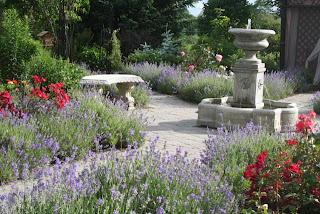
Similarly, the central portion of our garden is an area that we consider to be a formal English garden. My guess is that many residents of the UK would look at our garden and raise at least one if not both eyebrows at us for calling it that. Even Gertrude Jekyll herself would probably shudder, despite the fact that our “formal” beds are hedged with her very own Munstead lavender rather than traditional boxwood, which we can’t grow here in this micro-climate to save our lives.

Perhaps it would be more accurate to say that our main garden was “designed in the English tradition”, and our front and side gardens are “modeled after the cottage style”.  But that seems so stuffy, and besides, it’s so many more words. 

Ms. Sinclair described the controversy that once surrounded the Japanese Stroll Garden designed by Isamu Noguchi for UNESCO headquarters in Paris. Although that debate occurred more than half a century ago, ethnic sensitivities are alive and well around the world today. But I'm not sure it's possible to come up with a compromise that will keep everyone happy. The very thing that some find as an affront, others find is a compliment.

We wouldn’t want to offend anyone, their culture, heritage, or their homeland by calling one of our gardens something that it truly isn’t, but where does one draw the line? Is there such a thing as being "politically correct" when describing your garden on a blog that reaches people around the globe? What about naming a garden that welcomes the public through its gates? How does one begin to define "authentic", when even within a culture or a country, wide variations undoubtedly exist?

I hardly consider myself an “expert” in either formal or cottage gardens after the traditional English style, although I’ve certainly read and studied about them. Perhaps the solution is best reflected in the words of the late Potter Stewart, Associate Justice of the Supreme Court who, while struggling to define obscenity, stated simply, "....I know it when I see it."

That said, for ease of communication, around here at least, our various beds are referred to in terms of the prominent style or the theme we tried to evoke in each area, or that was the inspiration for the design. That’s not to say that we didn’t digress a bit in the individual beds when it suited our fancy. 

Ms. Sinclair gets to the crux of the matter when she asks whether we in the West have any understanding at all of the subtleties and symbolism inherent in true Japanese gardens. I doubt that most of us do, but I’m not sure that I need to in order to simply enjoy the influence of their style in my backyard. Maybe that shows colossal insensitivity toward another culture or country on my part, and if so, I assure you, it's unintended.

I can appreciate that people of other cultures may not be as laid back as I am when it comes to someone co-opting a word or phrase that has a specific definition or meaning in their culture and attributing it to something that may be little more than a poor imitation in their eyes.

The closest I’ve ever come to being able to experience this dilemma first hand involves food. An observant Jew, I have dined at many “kosher style” as well as authentic “kosher” delis. At a “kosher style” deli, you can usually get a side of bacon (and I don’t mean kosher turkey bacon) with your latkes. I wouldn't order it myself, but I don't begrudge you your bacon either. At an authentic kosher deli, bacon isn’t found on the premises and they would generally not serve a cheeseburger, even by special request.And that's fine too.

I personally don’t object to the word “kosher” being used whether for it's ethnic, religious, halachic, or colloquial meanings, as long as it is crystal clear to the patrons whether or not the establishment keeps an authentically kosher kitchen so that those who wish to observe the laws of kashrut when dining out may do so. Beyond that, I certainly know that if I see the word “kosher”, I can generally expect to find reubens, brisket, matzo ball soup, fresh lox, cole slaw, falafel, and fabulous deli pickles on the menu.

Having said all this, I wonder as well about the converse:  what does someone living in Japan call a garden built in Japan that boasts casual, informal plantings of English lavender, a rose or two, a fountain, a bistro set with an umbrella on a small patio area, some flowering ground cover, perhaps a trumpet vine or clematis climbing over a porch, and a bunch of daisies, violets, and some kitchen herbs tucked next to some zinnias? Would it be a Japanese garden, since it’s in Japan, or a cottage garden, since the elements it contains clearly evoke that style?

Author's Note:  If you have the chance to visit the James Rose Center, you are in for a treat. But definitely call ahead and make an appointment with the caretaker even if you plan to go during the public hours and be sure to get very specific directions to the location. There are no signs on the street - such signs are not allowed in the village and GPS gets you close but not exactly there! The entrance is on the adjacent side street and the only sign is a very small one on the gate, not visible from the road. We spent as much time searching for the landmark as we spent touring it! But it was definitely worth the trip.


Saturday, June 11, 2011

Update: The Saga of the Sand Cherry

Blooming in early May
Welcome to the next installment in the continuing saga of our sand cherry tree.

Our once glorious sand cherry tree was severely damage last winter when it was struck by a plow during a winter blizzard. We were delighted that after sustaining such widespread damage, it bloomed enthusiastically, perfuming the entire front yard. You can read the details and see the pictures here and here.

No sooner had the blossoms faded when the tree began to show signs of serious stress. Leaves were wilting, drying up, and falling off. Virtually every branch was affected.

Yet, the leaves closest to the trunk seemed to be healthy and the trunk itself was sprouting suckers. It looked to us as though the tree had used any nutritional stores it had to put forth the wonderful spring flower display, but was now struggling to support all of the new growth and even to sustain current growth.

We felt that lowering the workload of the tree was in order. We hoped that by trimming things back to a level that the tree could handle, it would be easier for it to continue to recover.

It started as an observation a couple of weeks ago, while we were doing spring cleaning in the bed surrounding the tree. Then, my husband decided to trim a few branches, cutting off the branches that had dead or dying leaves on them. As he gradually trimmed one side, I started opposite him. Before we were done, we had scaled the tree back to about a third of its original size.

May 30th, after pruning. The suckers along the lower branches appear healthy.

This picture was taken a week ago. The tree continues to thrive. Hard pruning seems to have allowed it to turn things around.

Friday, June 10, 2011

Wonderful Wandering Wisteria

No question about it, I love wisteria. While I have yet to smell one that has a fragrance even close to the shower gel I use that bears its name (a Crabtree and Evelyn fragrance), and in fact, am not overly fond of the fragrance of the wisteria in my garden, there is nothing quite like the vision created by those dangling clusters of blooms in early spring.

We have both Chinese wisteria (two different, unidentified varieties) and an American wisteria, "Amethyst Falls". When we bought the Chinese wisteria, (naively, without doing due diligence in the research department), everyone who knew I'd gotten them told me I was nuts to even consider planting them. And even more than that, what was I THINKING, buying $3 bargain wisteria plants at Wal-Mart??!!??

We purchased and planted planted two of them in 2006, positioned side by side, assuming they were the same variety (they were labeled simply as Chinese Wisteria). We hoped that at least one would grow.  Since they were packaged and labeled exactly alike, we never expected that they might be two different varieties.

They bloomed the second year we had them, one a true lavender and pale purple and the other a rosy shade of lavender and deep mauve. While their fragrance isn't unpleasant, it's certainly not something I would care to wear as a perfume. On the other hand, our neighbors have a purple wisteria that looks identical to ours and blooms a week earlier with a fragrance they find so off-putting, they keep the windows closed.

The Chinese wisterias are early bloomers, blooming a full 3-4 weeks ahead of the their American cousin. Like kids, they need boundaries, firm guidance, and frequent supervision. They do send out runners quite enthusiastically, and likewise curling tendrils that look for new places to gain a foot hold along a fence or wall, but as long as you stay on top of them and clip their wings occasionally (I usually trim mine once in spring, right after they finish blooming), you can keep it in check quite nicely.


I know people who have let them grow without any guidance and they have grown up into porch rafters, under shingles, and caused some structural damage. That doesn't happen overnight and they could have been reined in a bit if someone had kept an eye on them. One does need to be vigilant and control it to a certain extent, but that is true for all plants.

I also know one gardener who trained it over his porch and a covered passage to an outbuilding and it was well-behaved and stunning.

As climbing vines go, American wisteria is much less aggressive, much slower growing, a very laid back plant. It does twine just as strongly and just as vigorously about whatever you are letting it grow onto, but it does not spread as assertively as the Chinese wisteria. And while it does send out occasional runners, like the main plant, they are slow to take hold in the garden.


Both of my Chinese wisteria have the long (at least a foot) dangling wands of blossoms, with the lavender variety quite a bit shorter than the mauve variety. The fragrance of the mauve variety is also more attractive than that of its lavender fence mate.

The American wisteria produces tight buds that are short, fat and upright, and when in bloom, the flower clusters are shorter, stubbier, although the basic flower form is the same. 

From the get go, the American wisteria has been a much more prolific bloomer, although the Chinese wisteria definitely overtook it this year by a landslide. When we got them in 2006, the Chinese wisteria were 3 year old plants (at least according to the package) and they bloomed for the first time in 2008. It was scarcely a handful of blooms, but they bloomed.

On the other hand, the American wisteria was a one year old plant when we got it in 2008. It arrived with buds and has bloomed every year since we got it.

Regardless of which type of wisteria you decide to grow, it will need to be able to anchor itself to something sturdy. We grew the Chinese wisteria on a wooden picket fence, and if I had to do it over again, I would have put it in a slightly different area of the garden where we have sturdy chain link.

The main trunks have literally fused with the pickets and rails of the fence and while I don't think this fence is coming down any time soon, if left to it's own devices, it would have taken over the gates and posts as well. While it does grow rapidly, it's not nearly the headache that kudzu is, so it's not a major job to stay ahead of it.

The American wisteria came twined on a stake and we left the stake in place, planted the vine, and let it climb across the top of the fence. Although it is far less prone to sending out runners than the Chinese wisteria, we prune all of them in the spring, trimming back roots that send out shoots into the lawn or adjacent flower beds, and also trimming back the vines as well. This is also a good time to root any cuttings, which should be rooted from new (green) wood using a rooting powder and potting soil.

The mauve blossoms of one of our Chinese wisterias are a full 18 inches long and have a milder fragrance that is more pleasant than that of the lavender blooms of the other variety.
The lavender blossoms of the other variety are a 6 inches shorter, with slightly larger individual blossoms and a more prominent fragrance. Neither plant was identified as to a specific cultivar when we purchased them.
We planted them together, hoping at least one would grow. The mauve bloomer is the one on the right and has sent a main stem to each side of the fence.
The blooms of the American wisteria are more compact.
The Chinese wisteria finished blooming a week ago and have now put their energy into leaf growth and sending out runners and vining branches. This is when I usually prune them back. We ignored them last year for a few weeks and they literally tied the gates closed, just as they are trying to do now!
A week after they finished blooming, the vines are fully leafed out and beginning to send twining tendrils in search of new places to set anchor.
The American wisteria at peak bloom in this photograph taken yesterday, anchors our "yellow" garden.
 This year we are adding a white wisteria to our all white partial shade garden, hoping it will twine happily and beautifully over a trellis we have there.

Thursday, June 9, 2011

Here Comes That Rainy Day Feeling Again...

Late this afternoon,  weather alerts started to ping on my computer screen and I turned to the TV for local updates.  I could feel my stress level rising as I listened to the forecast and thought, Oh, no, not again! Severe weather was heading our way and while there were no tornadoes expected, we were told to expect winds to 60 mph, golf ball sized hail, lightening, and rain.

Last week, turbulent summer weather had spawned a tornado that leveled many neighborhoods in Springfield, Massachusetts and surrounding suburbs.  I was away from home at the time, getting updates by phone from my son as the storm system moved rapidly across the state.
 
It was a tense time and while we were spared any tornadoes or serious damage where we live, microbursts claimed their share of trees and tree limbs, roof shingles, and lawn furnishings in the area.

The storm moved in quickly and the sky turned black.
As the forecaster was telling us that the weather front would hit our area in an hour to an hour and a half, my son and I heard the winds pick up and sirens start to howl. We had little time to prepare.

We made sure that all four of our dogs were inside and safely downstairs. Within minutes, the sky had turned black and the wind gusts were ripping through the trees and curtains on the deck.

We struggled to remove the canopy top from the frame as cold rain (but mercifully no hail) pummeled us. We watched the trees whipping back and  forth and finally were able to take cover inside as switches of weeping willow whipped across the deck. What scared me the most was when leaves from the tree on the other side of the house came flying over the house, littering the deck.

The trees were blowing wildly with the wind.
After the storm, the deck garden was littered with branches from the neighbor's willow.

Willow leaves, and large clumps of leaves from a tree on the other side of the house were everywhere.
 The storm moved quickly and passed through the area in less than two hours, leaving a trail of downed trees and wires in neighboring communities and in ours. We were once again very fortunate: no power loss, no major damage. Five hours later, the temperature has dropped more than twenty degrees, the humidity has eased, stars are out, and the moon is peeking out from behind scattered clouds. And all is right in our little corner of the world.