Embracing Autumn.
 I've been trying to take my cue from all of the bloggers posting about the wonderful sights and smells of autumn but it's very hard for me to do. Spring is definitely my favorite time in the garden.
Not because autumn isn't beautiful, for it is. In fact, many would say that nowhere in the world is autumn quite as beautiful as it is in New England, where the fall foliage is usually vibrant, the red and orange and gold so vivid, the forests seem to glow as if on fire.
So why can't I enjoy the crisp air, the way leaves swirl along the edge of the driveway in the breeze, the changing colors and textures in the garden? Well, for one, if autumn is here, can winter be far behind?
This year, autumn has been less fun than usual, in part because the traditional fall colors have been muted in the extreme. I'm hoping that the brilliant hues we normally see are simply delayed.
The sugar maple across the street is usually a brilliant orangey red in late September. Last year (top photo), I collected leaves and waxed them to send to soldiers we support in Afghanistan and to decorate the table with for Thanksgiving.
This year, the leaves have all fallen and barely achieved a passable gold before they began swirling around the entrance to our driveway.
I hear that the color is better in the Mount Washington and Berkshire regions, but there is no question that rainy and cool end of summer weather has affected the fall color where we live.

Although autumn has definitely arrived in our gardens and most of the perennials have set seed and are going dormant for the winter, we still have a rainbow of colors. The roses, especially, are doing their part to make sure that the garden is alive with color and a haven for bees, butterflies, and birds.
The large swaths of blooming perennials are definitely a thing of the past, but virtually every summer-blooming plant has sent up a flower or two or more, providing sometimes unexpected pops of color throughout the yard.
Nothing says autumn in a New England cottage garden like wild asters. Owing to the influence of Nancy Ondra, we planted our first ornamental grasses this summer. The combination with wild asters that self-seeded in all of the cottage beds is a breath of fresh air after the disappointing foliage display!
The other big surprise this month is the lavender. We have our formal beds edged in Munstead lavender and it typically peaks in June. We trim it back in early August and usually get to enjoy a second, lighter bloom in September. This year, while some of the rest of the garden has struggled with the heavy rain and cooler than normal temperatures, our lavender (which normally isn't fond of being damp, mind you) has thrived and is stealing the show. The second bloom has been even more robust than the June bloom, and even after a more than a month, the hedges are still flowering enthusiastically.

I love to cook with lavender. I dry buds to use in baking, save wands to flavor the barbecue, and also burn wands in the fireplace in winter. I've added lavender to cupcakes, tea, and even to a meat rub. But my favorite use of lavender is definitely medicinal. I use commercial lavender oil on light bulbs to perfume the house and spritz our bedsheets with lavender linen spray. I find the fragrance helps me to sleep better and to relax when I'm anxious.
But we truly appreciated lavender as a medicinal herb following our tricolor Cavalier King Charles Spaniel's two neurosurgeries. Spencer (Eulenburgs's Voyage Home, Spencer Tracy) earned his nickname "Toughie" because of the determination he showed to survive a catastrophic congenital brain malformation that left him near death when he was four months old.
Keeping him on bed rest after both his first emergency brain operation and his second operation a year and a half after the first for insertion of a shunt was made tremendously easier with the use of lavender, which I put in his food and sprayed on his bedding in his pen.
With the room totally perfumed, I'm not sure who it helped the most, him or me. But three years later, if he has a headache or is experiencing an increase in neurological symptoms, he will immediately seek out the lavender and self-medicate. When I see him lying on the hedges or nibbling on the buds and blooms, it usually means a visit to the vet is in the offing..
 |
| This photograph was taken this week, just before Toughie's most recent visit to the vet for his acupuncture treatment. |
The roses continue to send forth fragrant, gorgeous blooms, although many are somwhat stunted by the persistent rain and cold. late summer and fall perennials are putting on a show, and there is beauty in the seed pods, garden visitors, and even in some of the weeds!
Although there is plenty of yellow, white, orange, and pink to go around, the red roses are stealing the show this week. The Double Red Knock-Out's are covered with blooms, and both Mister Lincoln and Olympiad have provided bouquets for the house. But the real treat this week has been Dublin Bay. Although it's a climber, we prune it and grow it as a shrub rose. This rose has shown a remarkable resistance to mildew and the dark red blooms are stunning. The shrub has been covered with blossoms for the past month.
 |
| Sprays of Double Red Knock-Out roses are plentiful. The red and white open faced bloom of the Fourth of July climber are a luscious blend of red, white and pink. |
 |
| Some of the red beauties blooming today are Dublin Bay (top left), a climber that we prune and grow as a shrub rose, Olympiad (top right), Double Red Knock-Out (bottom left), and Mister Lincoln (bottom right). |

Also filling the garden with red are the geraniums and a late summer surprise, Pineapple Sage
(Salvia elegans).
When we bought the sage, we got it because I loved the fragrance and thought it would be fun to cook with. And indeed, I used it to add a hint of pineapple goodness to some meat dishes and cupcakes over the summer.
I was surprised this week when tall spikes of red flowers began blooming in the herb garden! My first thought that was that it looked like the cardinal flower we see growing along the river banks where we canoe. A sniff of a leaf confirmed that what had been a relatively compact plant for much of the summer now looked like an herb on steroids and had attained a height of 4 feet seemingly overnight.
Other pops of red are showing up everywhere in our pots and container plantings where an assortment of both Nova geraniums and ivy geraniums continue to fill the planters with color.
 |
| Geranium blossoms from some of our container gardens. We also had assorted pinks, white, and lavenders but none of those are blooming although several buds are ready to open. We'll bring many of them in for the winter. |
The pink roses are just behind the red when it comes to beautiful garden color. Pink blooming perennials are also doing their part to provide late summer color.
 |
| Lovely pink roses currently in bloom include Bonica (top left), Cape Diamond (top right), Wisely (bottom left), and Passionate Kisses (bottom right). |
 |
| We are also enjoying Gertrude Jekyll (top left), Blushing Knock Out (top right), Cupcake (middle left), Memorial Day (middle right)., Lady Elsie May (bottom left), and Mary Rose (bottom right). |
 |
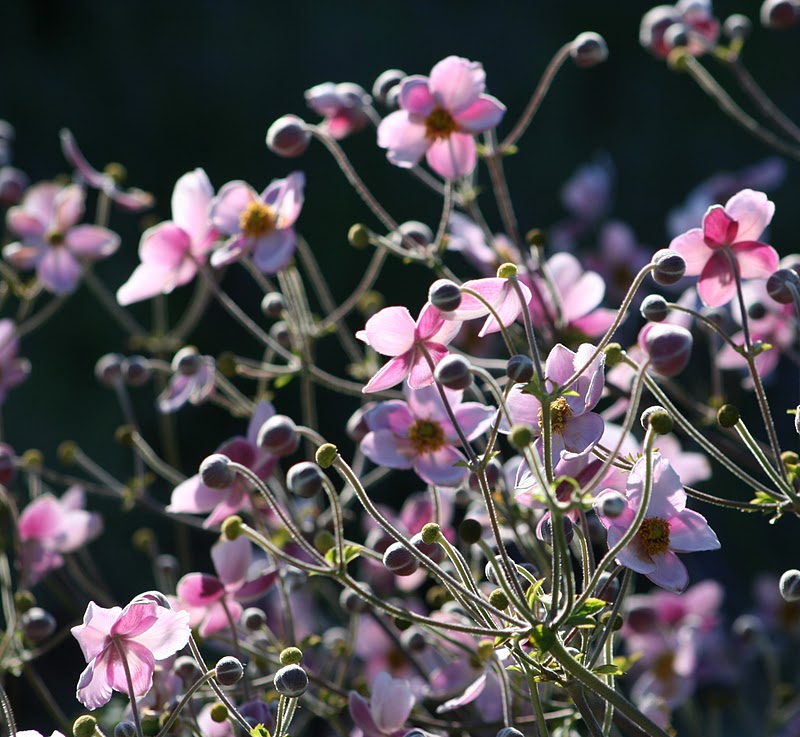
| A few Japanese Anemone blossoms are still blooming in most of our beds, although nothing like they were a month ago (top left). A deep pink zinnia (top right) from one of the raised beds on the deck - we also have them in the perennial beds to give fall color; The spirea continues to bloom (bottom left); Sedum Brilliant (bottom right) has given a brilliant performance. |
 |
| Left Top: Snapdragons that have been growing in one of the planters around the base of one of our potted trees. Bottom left: A striking pink phlox. This popped up unexpectedly in a spot in the garden where I don't recall ever planting any phlox, and the plant is only about 24 inches tall. Right: We still see some coneflowers here and there through the garden, although most have faded and the tops have dried. |
|
There is precious little orange in our garden this time of year, aside from the Monarchs which have been visiting our Butterfly Garden for the past 6 weeks, and some of our koi. The orange lilies are busy producing seeds, their blooms long since passed. And the foliage that usually provides brilliant orange color has been a major disappointment. The "orange" roses, Tropicana and Fragrant Cloud, which have been blooming all summer, have slowed down and although they are both sporting buds on several stems, with the cooler temperatures and shorter days, the blooms are much slower to develop.
 |
| The violas benefited from a late summer haircut and are once again covered in blossoms, many of which I have pressed to use in paper crafts over the winter. |
 |
| Top: Lavender wild asters, lavender phlox; Bottom: Plectranthus 'Mona Lavender', Cranesbill "Jolly Bee" |
 |
| Left: Lavender Mexican Heather, Cuphea hyssopifolia; Right: Purple petunias |
 |
| Buddleia, Butterfly bushes,"Dark Knight" (purple) and "White Profusion" (white) |
 |
| "White Profusion", white butterfly bush with a carpenter bee seeking nectar. |
 |
| Clematis Henryii on the left, a single bloom on the left lamp post. A single lavender bloom (cultivar unknown) also appeared on the strawberry garden trellis. |
 |
| Top Left: Wild asters, white. Top Right: White straw flowers. Bottom left: Montauk Daisies, which do not usually re-bloom to this extent, are blooming again in in the herb garden. Bottom Right: White echinaceaa (coneflowers). |
 |
| Although it appears almost creamy when the buds are just opening, the bloom on the left is John F. Kennedy and will open into a beautiful white tea rose. If the middle bloom, Lace Cascade, looks familiar, it's because of its relationship (identical) to Iceberg. Lace Cascade is a climber, and I'm not sure why it wasn't simply named Climbing Iceberg. The New Dawn blossom on the right is the palest pink, having opened a slightly deeper shade and then faded nearly white with age. |
The nights are getting colder and the days shorter, and we have already begun the task of preparing the beds for winter. While most of the perennials have stopped blooming and seed heads are drying, we still are able to enjoy beautiful rose and perennial bouquets. Even as the perennials slowly fade, the roses will continue to bloom right until it snows.
The other hallmarks of the fall garden are the fruits and berries that provide food for us and winter food for the wildlife in the area. I'll feature those in next week's foliage tour of our gardens.
Garden Bloggers' Bloom Day is the brainchild of Carol who blogs about her gardening escapades at
May Dreams Gardens. Like me, Carol is a lover of spring (May in particular) who invites gardeners to record the blooms in their garden every month throughout the year on the 15th of the month. You can read more about it on her blog where you can also find links to tens of dozens of other gardens who celebrate their gardening blooms each month with Carol. Click
here to visit Carol's fabulous blog!
 Embracing Autumn. I've been trying to take my cue from all of the bloggers posting about the wonderful sights and smells of autumn but it's very hard for me to do. Spring is definitely my favorite time in the garden.
 Although autumn has definitely arrived in our gardens and most of the perennials have set seed and are going dormant for the winter, we still have a rainbow of colors. The roses, especially, are doing their part to make sure that the garden is alive with color and a haven for bees, butterflies, and birds.


 Also filling the garden with red are the geraniums and a late summer surprise, Pineapple Sage (Salvia elegans).