Showing posts with label Book Review. Show all posts

Tuesday, May 8, 2012

A Book Review, of Sorts: Dig, Plant, #?%\&... A Gardener's Soap Opera

It's raining today.  Pouring buckets. Raining cats and dogs. 

I'm not loathe to gardening in the rain; in fact, it's one of my favorite times to plant and weed. 

Unfortunately for my garden, however, I've been bitten by the soap opera bug. 

Can you think of a better thing to do on a rainy spring morning than curl up by a cheery fire and read a soap opera?  Yes, you read that correctly.  I am reading a soap opera.  

The first soap opera truly dedicated to gardeners is being written by none other than Noel Kingsbury.  Dr. Kingsbury is an internationally renowned garden designer and author. 

I first came to know him as one of the fabulous regular contributors at Gardening Gone Wild.   Although he has some twenty books to his publishing credit, it's his latest venture that has me chomping at the bit for more.

Dig, Plant, Bitch is a soap opera dedicated to those of us who live to dig and plant in the dirt and then ---  well, you know, complain about it all the while loving it.

The only thing televised soap operas have on the Kindle version are pictures (which wouldn't help me much with my oldie but goodie non-Fire Kindle, which no, I have no plans to trade up).  Dig, Plant.... etc. has all the "staying power" of a true soap:  characters that gardeners the world over can identify with, intrigue, tantalizing conflicts, and cliff hanging endings to each installment.  Best of all, you can tune in whenever you want and there are no commercial interruptions at critical times in the plot.

The first installment hit the cyberwaves in early March and the second installment was published mid-April.  This morning I am closing in on the end of the second installment, knowing as I do that another installment is probably a few weeks away, yet.  Oh, how shall I manage until then!

Luckily for me, I shan't be bored.  I'm anxious to "dig into", Fran Sorin's Digging Deep, another recent book purchase which I'll get to just as soon as I finish Georgette Heyer's, An Infamous Army, this month's  Almack's group reading choice.

Wednesday, August 24, 2011

Book Review: Weeds of the Northeast

Weeds of the Northeast by Richard H. Uva, Joseph C. Neal, and Joseph M. DiTomaso is one of those reference books that never goes out of date. My copy, which I only purchased a few months ago, is already well-thumbed.

I have yet to find a book about weeds that is as comprehensive and as inclusive as this one.  And while it focuses on weeds that are primarily found in the northeast quadrant of the country (north to Canada, south to Virginia, and west to Wisconsin), my guess is that it would be helpful for many other areas of North America as well.

The book is designed in such a way that identification of weeds can be accomplished relatively easily.  There are identification tables that differentiate similar weeds based on characteristics and multiple pictures showing each of the plants included at multiple stages of their life cycle.

I find myself walking through the gardens with the book in hand, quickly identifying things that have eluded my efforts to properly name them for years. Of course, one woman's wildflower is another woman's weed, and so my lone cautionary note is that not everything in the book needs to be pulled up and relegated to the compost pile.

While Virginia Creeper is classified as a "weed" for the purposes of this book, we have it happily growing over a chain link fence where the dark green leaves cover the unattractive metal fencing and the berries attract wood thrushes, warblers, and woodpeckers.

Likewise, Johnny Jump-ups are a staple in many of our beds and our two trumpet vines provide late summer color where they've been trained to grow.

That said, the information about each plant's growth habits, propagation, and root system has made it easier to eradicate weeds that are not welcome in our perennial beds and has helped us to effectively control those that we've chosen to cultivate and enjoy as "wildflowers".

Monday, July 4, 2011

Must-Have Garden Guide: "Foliage" by Nancy Ondra

by Steve and Cathy Wieder 

As a couple, we generally have very different taste in books, even books about gardening. Rarely do we collaborate as much on a blog post or a book review as we did on this one and in this instance we are of one mind.

Nancy Ondra’s Foliage is one book that we both feel is a “must have” that should find its way onto every gardener’s book shelf. 

Once again, Nancy has partnered with horticultural photographer Rob Cardillo. The result of this all-star collaboration is a premier foliage design bible and a true feast for the eyes. His vibrant photographs of each plant add a stunning visual accompaniment to the text.

Many of the photographs show the featured plant highlighted in one of Nancy's well thought out, mature garden beds. In photographs that capture the play of light in very varied gardenscapes, he demonstrates the contribution of individual plants within a complex design. 

We purchased this book earlier this spring when we began designing and planting a shade foliage bed. We sought guidance and design ideas to enhance the handful of heucheras, hostas and ferns we had already set into the bed.  We got that and more. We now have a plethora of ideas for our foliage bed but more importantly, we have come to view our other beds in a new and broader way.

Historically, the traditional focus in the decorative garden has been on the color and bloom time of flowers. Except in the case of ground covers, in most traditional gardens, foliage has been a secondary and largely ignored consideration.  This book turns that gardening philosophy on its head and brings the foliage front and center.

What sets Foliage apart from other gardening books we’ve read is that this book is not a didactic lecture about foliage or an alphabetized compendium of plant descriptions. It’s an intimate conversation with someone whose encyclopedic knowledge and love of foliage and gardening shines through in every paragraph.

Not only is this book extremely well-written and comprehensive, there is a very personal quality to the writing. She writes to the reader, and to readers of every skill set and gardening style and preference.

Her intimate knowledge of every plant, from having grown and watched them over time, suffuses the writing.  She uses adjectives in a way that brings her vivid descriptions to life as easily and as brilliantly as the photographs do.  

The book opens with excellent introductory information about a wide range of considerations when looking at foliage in the garden, from plant selection, to leaf characteristics, to leaf diseases. She follows that with a carefully compiled and researched description of each plant. 

Foliage is a goldmine of color and texture for the garden, organized in a garden-friendly way. Listed first by color (do you want gold, blue, purple, or red in the foliage?) and then by leaf type (do you want fine feathery leaves or something spiky or large and bold?), she has foliage plant options for every nook and cranny of your garden.

As she does in her other equally excellent books, she includes growing tips that she has gleaned from decades of experience and she includes alternatives for creating a similar look with different plants for different hardiness zones and light and shade requirements.  

Scattered through the book are tables that are comprehensive and very helpful, and not just your basic list of plants.

For a novice, the tables provide a user friendly guide for making choices based on whether you are looking for a sun or shade plant with foliage in any color and leaf texture.

Our favorite is a table in her “What’s in a Name” series of tables in which she lists and explains words included in a plant’s name that indicate that the foliage may be variegated or unique in some other way.

Nan Ondra demonstrates in a dramatic and concrete way that color enhances texture and texture enhances color.

By looking at foliage in the context of a garden bed, rather than by focusing exclusively on individual plants, she encourages the reader and gardener to expand their perspective to consider and appreciate the plant as it visually relates to everything around it.

This book illustrates how the contribution of foliage to the richness of a garden bed fulfills the maxim that "The whole is greater than the sum of its parts."  In each chapter and in each color grouping, she combines plants with different growth habits, height, leaf types, and colors to create a dramatic visual impact.  

Foliage offers a different kind of palette for the decorative gardener. What we have taken from this book is an expanded focus that extends beyond the short bloom season of our many perennials to encompass those aspects of the plants that embody the ongoing contribution of each to the garden as a whole.

We now have an enhanced appreciation for foliage as a source of visual interest and complexity throughout the growing season and into the fall and winter. In so doing, despite the changing seasons in New England, our garden can “bloom” year round.


Foliage is available in both hardcover and paperback at Amazon.com.


Saturday, April 2, 2011

Book Review: The Perennial Care Manual by Nancy J. Ondra

As a longtime gardener, one aspect of gardening that often confounds me is what to do when the perennials stop blooming. I have been hunting for an easy to follow guide that would tell me which ones to cut back, how far, and when.

Over the years, my husband and I have acquired no less than a half dozen books that promised to be "complete guides" to perennial gardening, yet they invariably fell short with regard to seasonal care and troubleshooting. My Wish List has long included a thorough guide to actually caring for perennials throughout the year.

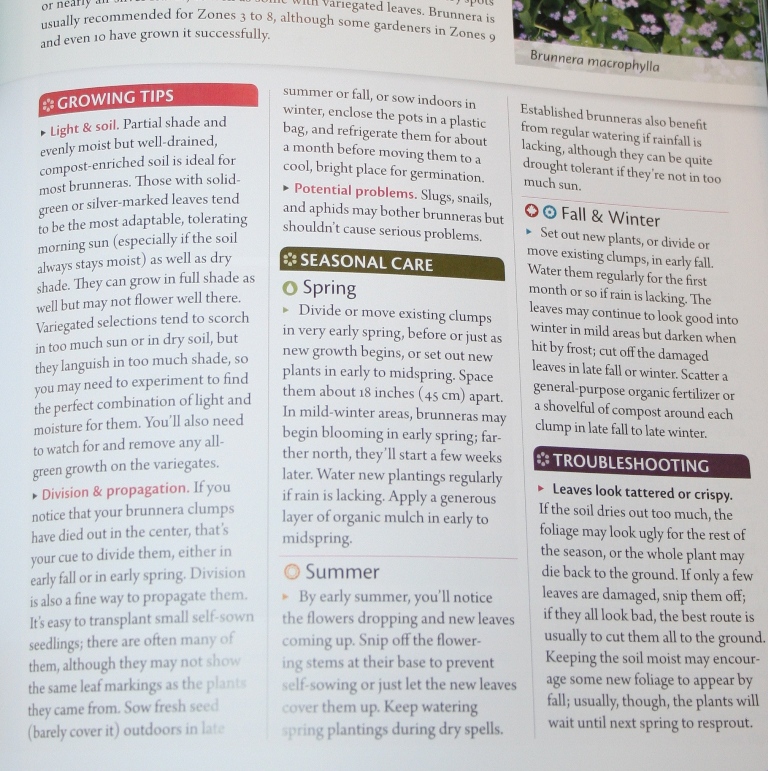
Nancy Ondra's The Perennial Care Manual fits the bill exactly and is the  comprehensive, easy to read guide that I was looking for. This is a book that every backyard gardener, both inexperienced newbies and those of us who have been around for decades, will find useful.  Filled with tips and information that is organized seasonally, with beautiful photographs by Rob Cardillo, this book instantly became my "Bible" for perennial gardening.

The book opens with a comprehensive review of perennial gardening "basics". I was delighted to see the attention she paid to preparing the garden bed. My husband and I learned the hard way that preparing the bed properly is the single-most important step in building a garden. From practical tips, like using laundry baskets to shade new transplants for a few days, to discussions about invasive plants, mulch, compost, and identifying and dealing with garden pests and weeds, the wealth of information in the first one hundred and twenty pages is incredible.

The second section of the book is devoted to the growing habits, propagation, seasonal care, and problems that affect individual perennials. Ms. Ondra chose 125 common perennials to feature and with each one, she goes through season by season, describing what to do and showing with wonderful photographs how to do it. She also describes and shows pictures of plant diseases, pests to watch for, and specific growing tips that are keys to success with certain plants.

When I first spotted the book at the Massachusetts Horticultural Society's book booth at the annual garden show last month, I immediately flipped to the two perennials that I always struggle with in terms of season-long care - peonies, which I absolutely adore, but whose heavy heads invariably sag, and phlox, which likewise tend to flop and sprawl. Her commonsense suggestions for dealing with both of these problems were remarkably simple, yet I had not read them in any other reference (nor thought of them myself).

For each perennial she gives spot on, very specific information about propagation, growth habits, and care throughout the year.  The pictures are spectacular and range from distinctive or common cultivars, to pests and diseases, to techniques.  The information is organized in a way that is user friendly and makes it easy to both search for a specific piece of information and assimilate information about a particular plant's habits and needs.


It's hard to find anything to say about this book that isn't "over-the-top" positive. I wish the book was twice the size - more varieties within different plant types, and more plants period. (Maybe she'll come out with Volume II?) And I wish she had included more information about weeds. (I know, that wasn't her focus, but the information she did include was fabulous - I could have used a hundred more pages of it!)

Listing at just under $25.00, this book is a bargain-priced goldmine of information. I will be watching for future books by this same author. We paid full fare for this book at the garden show but a quick peek at Amazon.com brought up a list of her past accomplishments that includes two books that quickly rose through the ranks and won the top spots on my Amazon Wish List - I'll be getting those in the very near future as well. Her books are discounted at Amazon, but I don't regret paying the list price at the garden show - it's worth every penny and more. (In fact, I thought the list price was a bargain, compared to some of the books we've bought in the past.)