Showing posts with label Laurel. Show all posts

Tuesday, June 7, 2011

The "Comeback Kids": Dwarf Cherry Laurel

This spring, our Dwarf Cherry Laurel (Prunus laurocerasus), Otto Luyken, bloomed for the very first time. This might not seem at all special to most gardeners, but the history of these plants makes this a rather impressive event. Just a few years ago, they were sitting on a dusty shelf at the local Home Depot, about to be tossed into the dumpster.  I couldn't be happier that they have made quite the comeback.

Often called English Laurel or Common Laurel, we bought the plants near the end of the growing season five years ago.  When we got them, they were undersized, pathetic-looking potted shrubs that were dwarfed by the one gallon containers they were potted in.  We spotted them sitting on a shelf marked down for quick sale with other equally sad looking perennials. They appeared sorely neglected and many of the leaves were yellowed and spotted, probably with some sort of fungus.

Now ordinarily, I never buy a plant that doesn't already have a designated home in our garden and I am very particular about buying plants that even hint that they might be infected. And I wasn't even looking for Cherry Laurel. I had been looking for mountain laurel shrubs for two years, but both nurseries who usually carry it around here had sold out of it very quickly and had already been out of it when we went to purchase it early in the season two years running. 

The bed we were looking to plant mountain laurel in was a new bed along the back of the gazebo that was mostly shady. I'd placed some dwarf fringed dicentras and some columbine there, but I was looking for mountain laurel to really anchor the bed and I wanted to buy four of them. The only thing these plants had going for them was that there were four of them and we had four spots to fill.  We bought them. 

From our almost weekly trips there for manure, topsoil, peat, pots, bricks, garden tools, trellises, and plants, we'd gotten to know the Plant Department manager who worked there at the time fairly well. I commented to her that they were the saddest looking plants I'd seen in a long time and they looked like they needed some love. She said they were headed for the trash. When I told my husband we should buy them because no one else would, he did the eye roll thing but he didn't say the magic words: "No way."  The plants on the shelf were marked down to $5. She said we could have them all (there were four of them) for $5 - they were literally about to be thrown out. When we paid for them, I think the clerk thought we were as good as throwing our five dollars away. I know I did.

When we arrived home, I segregated them out front, pruned the skanky leaves, and fed and watered them. I sprayed them with my usual garden spray mixture but went a little heavy on the soap and oil.  Ordinarily, given their condition, I would have wanted to isolate them from the rest of the garden until they started to show some new, healthy growth and appeared disease free (or cured). But since it was already closing in on the end of September, I needed to get them into the ground so they could establish a root system before the ground froze. As soon as I got them "cleaned up", into the ground they went. 

At the time, I knew nothing about Dwarf Cherry Laurel. The care and planting labels that are usually on the pots were long gone and the plant tags gave little information other than the plant cultivar name.  But I knew about mountain laurel, so assuming they couldn't be much different (and we all know what the meaning of the word assume is...), these four little scraggly shrubs, which I later came to learn ordinarily like full sun to part shade, ended up in a very shady garden, where, unbelievably, they have thrived.

Dwarf Cherry Laurel is ordinarily a slow to medium growing plant that needs minimal care but does require a fair amount of sun. Because they are in a garden bed that is generally out of sight (and out of mind), except for the usual spraying and feeding that the entire garden gets, they have experienced a fair amount of benign neglect since we planted them. I do make the rounds of the garden regularly with Steve, and many times, the thought, "What was I thinking?" has popped into my head. 

This year the plants have reached a height of about 18 inches high and just a bit wider, triple the size they were when I planted them. They are planted in a rich humusy soil, but I suspect the lack of full sun has slowed their growth rate even more than what is normal for them.

When I saw the flower spikes this spring, I was amazed. When the blossoms opened, I was pretty impressed with the fragrance. Although the tiny blooms faded within a week (and that could have been weather related), it was a delight to see them bloom nonetheless.


Tuesday, April 26, 2011

The Glories of Spring


Peonies spring up next to tulips and daffodils are blooming in the perennial garden.

The colors and fragrances of spring continue to burst forth throughout the garden. For the second week in a row, pansy faces greet us front and back and the garden hyacinths perfume our home and garden nside and out.
 
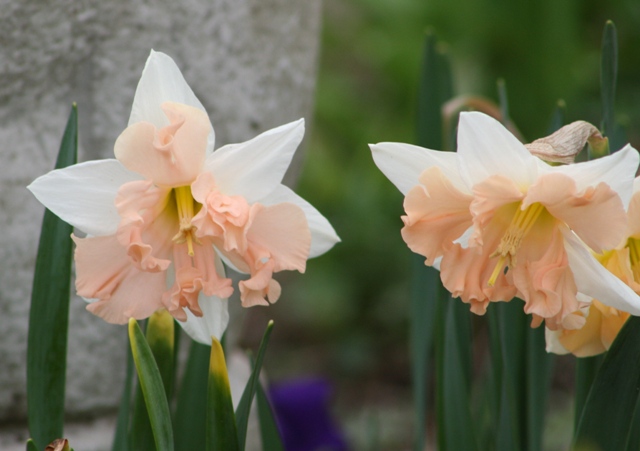
The earliest azaleas are blooming as well, but the prime showstopper this week is the constellation of daffodils that decorate each and every bed, in shades of ivory, butter, lemon, orange, peach, and pink.

The magnolias are not going to disappoint, as they did last spring. The star magnolia is fully in bloom and the mauve and cream saucer is not far behind. The first petals are just starting to tease away from the buds. The yellow magnolias will follow close on its heels and both trees are literally covered with buff and green buds.

Come, lets take a walk and enjoy early spring in the garden!

The cottage garden bursts with color and fragrance.


A sampling of the daffodils that bloom among the many beds in the formal and cottage gardens, Single and double and ruffled, with shades of white, yellow, peach, orange, butter, and pink, the colors and varieties are  as stunning as they are plentiful. We planted bulbs in clusters of at least a dozen to maximize their dramatic effect. 


The hellebores are stunning and long-lasting, and this year they have put on their most dramatic display to date.


The Cleveland Pear is budded
This laurel will be blooming for the first time!


Two of our koi, Goldie and Frick, scavenge for algae near the waterfall rocks. Water mint grows in the foreground.

Throughout the garden are areas to sit and reflect, read, meditate, or enjoy a mug of tea or light snack. This is the walkway into the back side of the tree grove where the star magnolia and the hellebores are blooming and the trillium is fully budded and ready to open. We often read the Sunday paper while sipping our morning coffee here in the shade of the variegated willows. When the viburnum and lilacs are blooming, the fragrance is indescribable.