 |
| A common European Starling, in our cherry tree, December 4, 2012 |
Despite what I find to be attractive markings on their plumage, for all of their handsomeness, starlings are generally regarded as "pests" in birding circles.
Not native to North, Central, or South America, according to
Wikipedia, they were first introduced in the United States in 1890-1891 by the American Acclimatization Society. Eugene Schieffelin, then chairman of the organization, felt strongly that all birds ever mentioned in the works of William Shakespeare should be present in North America as well. I am mystified as to what motivated him in this regard but he was apparently instrumental in bringing starlings and other birds to the continent. I wish he'd thought this through a little more carefully.
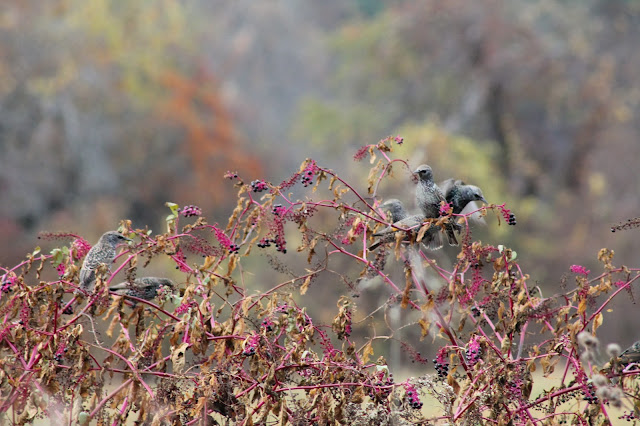 |
| November, 2012 -- Starlings eating pokeweed berries on a brief stop during migration |
I confess that prior to this year, I had little exposure to starlings. I'd seen a few birds here and there, even seen some small flocks from time to time when the birds are migrating in autumn. But mostly I saw them from a distance and if they stopped at our feeders or at any of the fruit producing trees or vines, it was only a few of them and they were here only briefly. In fact, I recall wondering if the many reports I'd heard of the problems they can cause might have been exaggerated.
As part of the Cornell Birdwatch Program, I was watching and counting birds at our feeders and in our fruit trees, and over the course of the fall months, the most starlings I ever saw at one time was a group of nine birds that flew in briefly, fed on some knotweed berries, and then flew off again.
 |
| Nearly every branch of every tree was lined with starlings. |
On December 4th, I heard a deafening sound that was so close, my first thought was that the low flying Medevac helicopter that ascends overhead on departure from the local hospital was flying precipitously low or having some kind of engine problem - a very frightening concern. But almost instantly I dismissed the thought -- the noise was different, strange, and the dogs were all barking as well. The Medevac helicopter is such a normal part of our day, we almost never "hear" it any more and the dogs wouldn't bark at it in any event.
When I went to investigate the source of the cacophony, I was stunned to find that every tree in our yard and on the adjacent property had been invaded by a massive flock of starlings that, based on counts we were able to make from a series of photographs I took at the time, numbered over a thousand birds.
Inside the house, the noise was loud, but standing outside on the deck, it was deafening. Birds filled nearly every branch of every tree and flew in clouds between them. Moreover, their distinct call sounded very aggressive and threatening. I called the dogs and our cats into the house and began locking doors and windows. Then I started laughing at myself - this wasn't Hitchcock's
"The Birds", I told myself. Clearly, my imagination was getting the better of me.
I was standing at the kitchen slider watching the flock flying in formation over our gardens when a small group of birds swooped over the deck. A couple of the birds hit the sliding door to the kitchen and fell to the deck, momentarily stunned, but then rejoined the flock. I continued to lock doors and closed the damper over the grill in the kitchen to chimney.
 |
| Starlings flew in several large flocks |
 |
| Every tree was densely covered with starlings. The noise was deafening. |
 |
| The cherry and apple trees were covered with fruit that would have fed the local birds and squirrels all winter. I took this photograph the day prior to the visit from the starlings. Here, a mockingbird is about to nibble a cherry. |
 |
| The starlings picked the cherry tree nearly clean of fruit and ate almost a third of the apples in the apple tree as well. |
 |
| The starlings picking away at the last of the cherries. |
 |
| A solitary starling perches on a branch after the cherry tree was picked nearly clean of fruit. |
 |
| Starlings cleaned up the cherries that fell to the ground beneath the tree. They clustered on the driveway, in the flower beds, and in the shrubs that grow under the two trees. They also devoured the seed from the two bird feeders that hang in the cherry tree, as well as every other bird feeder on the property. |
It took less than two hours for the birds to pick the cherry tree nearly clean of fruit. I'm not sure why they favored the cherries over the crab apples - the trees stand side by side in front of the house and the fruit are similar in size and color. Moreover, the cherries were not fully ripened, were as hard as the apples, and have a bitter taste compared to the apples. Although they clearly preferred the cherries, the starlings did manage to eat a sizable number of the crab apples. When I compared photographs taken a day or two before, it looked as though a third of the small apples had been eaten.
 |
| They also descended on all of our bird-feeders. Because we are so involved in the BirdWatch program, we have more than a dozen large bird-feeders and I had filled them all early in the day, the same day that starlings arrived. It takes me almost 25 pounds of seed to fill the feeders, which I do about every 4-5 days. After they were gone, I was startled to discover that every one of them was either totally empty or nearly so. This is one of the larger feeders and one of only two that had any seed remaining in it whatsoever. |
I had a hard time taking photographs as the birds flew in large flocks in and out of the tree, , throughout the back yard where they invaded all of our feeders, and swirled near the steps of the porch where I was standing. They were frightening and more than once I dashed into the house, although none of them actually threatened me in any way. I had never seen so many birds at one time.
The one good thing that came of this was that many cherries fell to the ground during the feeding frenzy and starlings fed on the cherries that fell into the garden and onto the driveway. Already, many cherries had been knocked to the ground by our resident squirrel and these cherries eventually sprout in the garden and between the pavers in the driveway and are a nuisance to have to weed out in the spring. After they flew off, there was hardly a cherry to be found on the ground.

We didn't see any more starlings for several weeks. Then, in the late
afternoon of January 11th, we were visited by another much smaller but
equally voracious flock. Steve was working at home that afternoon and
I went and interrupted him so that he could come out and witness the
spectacle. As before, there were birds perched on all of the trees, although not as densely as before. Periodically, they would fly from the trees in formation, swooping down over the meadow.
 |
| The starlings flew in several dense oval flocks like this one - their ability to move en masse without bumping into one another is amazing |
 |
| They made dramatic figure eight arcs over the adjacent meadow, at one point briefly setting down in the meadow, ostensibly to look for food. They quickly realized that the trees were a much better source of nourishment and headed back to the trees. |
Eventually, they settled in the apple tree where, to the dismay of the mockingbirds and robins, they began to feast on the crab apples.
 |
| Starlings eating the crab apples. |
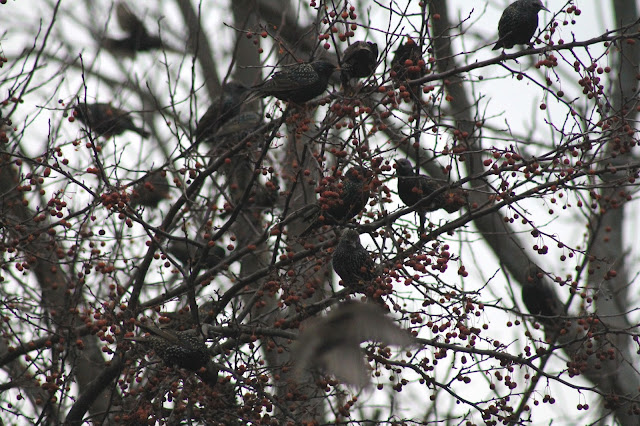 |
| It didn't take long before the starlings were picking the branches of the crab apple clean, in much the same way as they had eaten all of the fruit from the cherry tree just a month before. This photograph and the one above it were taken barely fifteen minutes apart. |
 |
| Until this experience, unless it was defending its nest, I had never seen a robin show aggression toward another bird. In fact, in our yard, all of the birds seem to co-exist quite peacefully. At one point, there was literally a screech-fest,with the starlings and robins cawing at each other. |
 |
| Several large robins, probably from Hudson Bay, had migrated south and wintered over in our yard. They perched in the tree and screeched at the invading starlings. The robins were not about to be chased from the tree nor let the marauding starlings make off with their entire supply of winter food. |
Things finally came to a head when our resident mockingbirds joined the fray. The mockingbirds love to sit in the top branches of the the trees and meow to the cats, who dutifully climb up the trees, looking for the "cat" friend who is calling to them.
In the midst of the uproar on this afternoon, three mockingbirds settled into the top branches and being to meow. Our cats, hearing the call of the mockingbirds, made a dash for the tree and climbed to the lower branches. The starlings flew off, leaving the robins behind. My guess is that the mockingbirds were attempting to defend their tree along with the robins and had no idea what an effect their particular call would have. Hearing the "meow", the cats climbed up into their favorite low branch and the starlings flew off, leaving the robins and mockingbirds behind. I was surprised that this large flock would be so afraid of two small cats!
 |
| As the cats climbed along the lower branches, the starlings took off, leaving the robins. The mockingbirds and robins have no fear of our cats, who frequently climb the trees when called by the mockingbirds. The cats have never shown any signs of aggression toward their feathered friends. Out of view are the mockingbirds in the uppermost branches and the cats on the lowest one. |
This was the last big flock of starlings to come through, and along woth our bird feeders, the fruit that remained was adequate to sustain the brids and squirrels


 We didn't see any more starlings for several weeks. Then, in the late
afternoon of January 11th, we were visited by another much smaller but
equally voracious flock. Steve was working at home that afternoon and
I went and interrupted him so that he could come out and witness the
spectacle. As before, there were birds perched on all of the trees, although not as densely as before. Periodically, they would fly from the trees in formation, swooping down over the meadow.
We didn't see any more starlings for several weeks. Then, in the late
afternoon of January 11th, we were visited by another much smaller but
equally voracious flock. Steve was working at home that afternoon and
I went and interrupted him so that he could come out and witness the
spectacle. As before, there were birds perched on all of the trees, although not as densely as before. Periodically, they would fly from the trees in formation, swooping down over the meadow.


