Showing posts with label Forsythia. Show all posts

Wednesday, May 15, 2013

Suddenly Spring.... Part 1


Winter seemed to drag on and on, teasing us with 8-24 inch snowfalls followed often immediately by 40 - 50 degree F days and snow melt.  Still, during the coldest weather, much of the garden slept under a generous snow cover, a welcome change from last year.  Our garden suffered tremendous damage when unprecedented warm weather kept the ground from freezing.  The resident moles and mice enjoyed a generous buffet of rose and hosta roots, echinacea and other perennials, and almost all of our crocus and tulip bulbs.  The cost to replace the lost plants was staggering.  (A total of 26 roses, almost a dozen hostas, most of our echinacea, and nearly a thousand bulbs was lost to the critter buffet.)

Spoiled by such an early spring a year ago, when I flipped over the calendar on the first of March this year, I was ready for some color.  Last spring, the snowdrops and hellebores had already been in full bloom for a week when I photographed them on March 9th.  This spring, it was the end of the month before we saw even our first hints of color.

The calendar said that spring was officially here on March 23rd, but it was another full week before spring truly arrived in this little corner of New England.

When I photographed the garden on March 30th, the snowdrops were blooming but the hellebores had barely poked their heads through the detritus of last year.   But once they started to wake up, almost overnight, they were standing tall, their cheery faces open to the sun.

This year, for the first time in several years, we have crocus popping up everywhere, singly and in large clumps.  Over the past few years, the mice and voles had eaten the many hundreds of bulbs that we had planted many years ago.

Clumps of purple, yellow and white giant crocus had slowly diminished and by last spring, except for a rare single bloom here and there, they had all but vanished from our garden. And replanting had proven futile.  After the passing of our cat, Frieda, the voles had claimed the garden as their own. 

This past fall, having finally gotten some measure of control over the critters that had been damaging the garden during the winter, we replanted many of the bulbs.   When we finally decided it was safe to replant, it had been too late to acquire the giant crocus I favor.  Since the smaller variety was in plentiful supply, we opted to try them to see if in fact we had the upper hand and we were not disappointed.  Planting nearly a thousand bulbs acquired at an end of season sale, our minimal investment blessed us with loads of springtime color this year, something we had been missing more and more over the past three years.  And it gives us the confidence to plant more of the varieties we love this fall.

Here in New England, April flowers brought May showers.  Despite unseasonably cool temperatures  and a lack of early spring showers, the several late season snowfalls were apparently adequate to meet the needs of all of the early bloomers and since the beginning of April, there has been a steady rainbow of color.


April 9, 2013:  Within days, the hellebores were blooming en mass.
April 9, 2013:  The last of our original purple crocus.
April 9, 2013:  We breathed a sigh of relief when the first crocuses pushed through the soil.
April 9, 2013:  The miniature iris are often one of the first things to bloom, but even these little gems took their time showing their vivid blossoms.
April 9, 2013:  Miniature Hyacinths sprouted en masse.
Mid-April, 2013:  The forsythia is in full bloom, as are the cherries and creeping phlox.  The hellebores have continued to grow and bloom, and daffodils and grape hyacinths can be seen poking out from behind other perennials as well.
Mid-April, 2013: The saucer magnolia was stunning, and beat the star magnolia by a full week.
Mid-April, 2013: A gorgeous saucer magnolia blossom, sprinkled with raindrops.
Mid-April, 2013:  Usually the star magnolia is the earliest of our magnolias to bloom.  This year, the star was the johnny-come-lately, blooming a full week after the saucer magnolia, with the blooms opening at almost the same time as the leaves.  Although the tree seemed heavily budded weeks ago, the bloom seemed lackluster and short-lived this year, possibly due to the weather.
Mid-April, 2013:  Usually not in full bloom until a week or two after the saucer magnolia, the buttery blossoms of  the yellow magnolia Elizabeth opened even before the saucer had reached its peak.


Late April, 2013: Usually the daffodils are a week or two or more ahead of the tulips.  I plant them together because they give extended color in each spot when they bloom sequentially, but even more than that, I hope that the daffodils will discourage the voles from eating the tulips.  When we planted these bulbs last fall, we mixed an assortment of bulbs in pink, yellow, and white blends, planted 15-30 bulbs together, and left it to luck to see what would bloom in each clump.
Late April, 2013:  An assortment of pink tulips grown together makes a bouquet too beautiful to cut and bring indoors.


Late April, 2013: Tulips and daffodils are abundant throughout the perennial and cottage beds. The grape hyacinths, which had been blooming for weeks, were still in bloom for World Hyacinth Day (May 7th), although the common hyacinths were a few days late for the party.
May 8, 2013:  The grape hyacinths have been blooming for weeks, the perfect early spring  ground cover.  We have them planted around most of our spring flowering trees.
May 8, 2013:  Although we have lilac varieties that bloom early, mid, and late spring, the common lilac, Syringa vulgaris, is going to be in full bloom for Mother's Day this year, right on time.  Since I was a young child, I've always associated Mother's Day with lilacs.

The color parade continues.  Tomorrow, for Garden Blogger's Bloom Day, I'll post photographs of the garden as it looks this week.

Tuesday, April 26, 2011

The Glories of Spring


Peonies spring up next to tulips and daffodils are blooming in the perennial garden.

The colors and fragrances of spring continue to burst forth throughout the garden. For the second week in a row, pansy faces greet us front and back and the garden hyacinths perfume our home and garden nside and out.
 
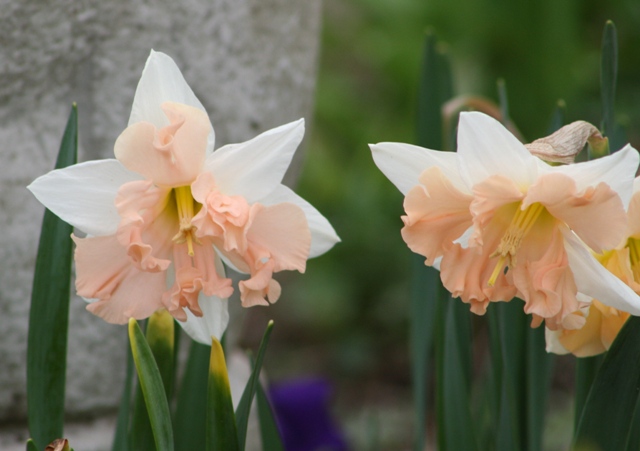
The earliest azaleas are blooming as well, but the prime showstopper this week is the constellation of daffodils that decorate each and every bed, in shades of ivory, butter, lemon, orange, peach, and pink.

The magnolias are not going to disappoint, as they did last spring. The star magnolia is fully in bloom and the mauve and cream saucer is not far behind. The first petals are just starting to tease away from the buds. The yellow magnolias will follow close on its heels and both trees are literally covered with buff and green buds.

Come, lets take a walk and enjoy early spring in the garden!

The cottage garden bursts with color and fragrance.


A sampling of the daffodils that bloom among the many beds in the formal and cottage gardens, Single and double and ruffled, with shades of white, yellow, peach, orange, butter, and pink, the colors and varieties are  as stunning as they are plentiful. We planted bulbs in clusters of at least a dozen to maximize their dramatic effect. 


The hellebores are stunning and long-lasting, and this year they have put on their most dramatic display to date.


The Cleveland Pear is budded
This laurel will be blooming for the first time!


Two of our koi, Goldie and Frick, scavenge for algae near the waterfall rocks. Water mint grows in the foreground.

Throughout the garden are areas to sit and reflect, read, meditate, or enjoy a mug of tea or light snack. This is the walkway into the back side of the tree grove where the star magnolia and the hellebores are blooming and the trillium is fully budded and ready to open. We often read the Sunday paper while sipping our morning coffee here in the shade of the variegated willows. When the viburnum and lilacs are blooming, the fragrance is indescribable.

Friday, April 1, 2011

Forced Magnolia Blossoms - Our First Ever!

After seeing branches of magnolia blossoms mingled with forsythia, both of which had been forced for blooming at the Massachusetts Horticultural Society's Flower Show this year, I went outside and snipped a few branches and brought them in.Forcing forsythia is nothing new; I've done it almost every year since I was a young a child. But I must admit that I had a certain amount of skepticism with regard to the magnolia blossoms, so I'm pleased to be able to share this photograph of the first magnolia bloom I have ever forced indoors in spring. On the tree, the petals are much larger and while they are the same creamy color, they have burgundy tinting along the edges and  and a deep burgundy throat,  and the blooms are at least three times the size of this blossom. I'm not sure if adding a small amount of dilute fertilizer would improve the size and quality of the forced blooms or not, but since our two Elizabeth magnolias and our star magnolia are also budded, I am going to experiment and see if it makes a difference.


Still a mystery to us is the identity of  what appears to be a June flowering magnolia that sets buds and blooms after the tree is fully leafed out. The blooms are a homogenous rich ivory color and have the classic saucer magnolia shape and petal arrangement. At left is a photograph of a leaf cluster and the seed pod taken last summer after it finished blooming.

We purchased the tree at a local family owned garden center. It was one of three trees that we got at the end of the season. The trees had been discounted by 70% and although we didn't realize it at the time, all three had been mislabeled so all were complete surprises when they bloomed the following spring

The magnolia had been tagged as a dogwood but comparing the leaves and the arrangement of the leaves on the branches and twigs, there was no similarity to our other dogwoods. When the blossoms appeared at the end of June, we were stunned to see saucer shaped magnolia blossoms. If anyone knows the particular variety of this magnolia, we'd love to identify it. I'll try to post a picture of the blossom later this summer.

A bargain priced white dogwood was actually a brilliant, carmine-blooming red Chinese dogwood. In the photograph at left, it is situated in the middle of the picture, just to the left of the Japanese maple and behind the deep rose azalea.

What makes the fact that we got this tree so unusual is that I had wanted a red dogwood but was told by the nursery manager that they were expensive and didn't sell well, so they didn't carry them. This tree looked like a dogwood and I had no reason to suspect it was anything but the white dogwood I expected until it bloomed the next spring. When we went to the garden center the following year for spring purchases, I told them about the tree and they told me it was "impossible". When the blossoms first open, it is the same color as the azalea - a striking image behind the waterfall.

Rose of Sharon grown as a standard
A tree labeled "Japanese snowberry" (which, incidentally, looks nothing like a true Japanese snowberry), is actually a Rose of Sharon grown as a standard - something else we don't know what to do with, since the leafed and blooming branches are too heavy to remain erect on the trunk.

The first couple of years, it wasn't an issue as the branches were short. Now that the tree is maturing, the top is taking on the conformation of a shrub and the trunk isn't able to support the growth. We've talked about pruning it back into a round shape or weighting the branches and pulling them down around the tree in an umbrella fashion. Once they are leafed out and blooming, the branches naturally tend to lean and bend down toward one side, causing the tree to tilt awkwardly. By tieing the branches together, we've been able to keep it upright.

Our thought was that since they naturally seem to want to bend anyway, why not train them to bend and cascade down in a more balanced way? We were initially discourage from even attempting this, but at this point, our only other option is to either seriously bob the tree and keep it pruned, or dig it out and replace it. We'll keep you all posted?

Friday, March 25, 2011

Spring is Here - At Long Last!


After one of the snowiest winters in recent memory, Spring is  finally here - not just on the calendar, but in our home and yard as well. The garden burst forth this past weekend with our first blooms of the year:  snowdrops are blooming in the cottage garden and today, I saw the first crocus buds as well, just ready to open.

Earlier this week I snagged some tulips and daffodils at a local flower shop and the grocery store and filled vases throughout the house. We have been watching excitedly as the snow cover has melted away to reveal mounds of green where spring bulbs and eventually summer perennials will be blooming.

After a visit to the Massachusetts Horticultural Society's annual Flower Show in Boston, I found myself more inspired than ever to begin the spring gardening chores. I began by clipping forsythia wands for forcing indoors and his year, inspired by a display I saw at the flower show, I snipped some branches from our saucer magnolia as well.

Forcing forsythia and magnolia blossoms
This is my first attempt at bringing branches of our saucer magnolia tree indoors to force.  And this is especially gratifying for me because I had been concerned that with the funky weather we had last fall, I might not have any magnolia blossoms at all.

Last spring, we had scant blooms on our burgundy and cream magnolia and the yellow magnolias' blooms were sparse as well. After an exuberant bloom the year before, we were disappointed that the trees were nearly devoid of color last Spring. But this week I was delighted to see the branches full of plump velvety buds and I know that the trees are going to be gorgeous in another few weeks.

The rhododendrons are also in excellent shape, considering the many feet of snow that buried them for the last three months. The Nova Zemblas are full of buds and the leaves show none of the drying effects of winter. Our white rhodies, the catawbiense "Choinoides", also seem to have had new life breathed into them over the winter after a difficult spring and summer last year. 

Everywhere I look, mounds of green and green leaf spikes are poking through the mulch. The benefits of the heavy snow - insulation and ample water - are obvious. But so are the casualties. In particular, our sand cherry is likely a total loss, and for that we are dismayed.

For reasons we can't quite fathom, the plow service piled heavy wet snow on the sand cherry, instead of pushing it into the wide open space along the walkway to the shade gardens and the back yard. Every branch cracked under the strain and the main stem has split as well. Last year, the sand cherry was a stand out in the spring garden, covered with pink blossoms. We were hoping for the same this spring. Sadly, it looks as though we'll be seeking a replacement.

In the first picture, the tree has actually been totally bent to the side and the branches poking through at the top are actually from a side branch. We knew then that the tree was in trouble, but there was little we could do. After the snow fell, it rained, then froze. We couldn't dig it out and were forced to wait for warmer weather and for the ice to melt.
Just the tips of a few branches poke through the six-plus foot pile of snow crushing the sand cherry.
Every branch has evidence of damage from the weight of the snow.
Damage to the sand cherry - March, 2011