Showing posts with label Dogwood. Show all posts

Tuesday, July 19, 2011

Who Put the Dog in Dogwood

We love our kousa dogwood (Cornus kousa).  A five foot tall twiggy sapling when we planted it in 2006,  it has since morphed into a sprawling, gracious tree that is now an impressive 12 feet high with a spread of 15 feet.

It's breathtaking when it's in full bloom in the spring and equally stunning in the fall when the leaves become a gorgeous carnelian with hints of purple and the fruit ripens to a deep maroon red.

The showy "petals" are not petals at all.

What is often mistaken for a flower is actually a cluster of leaf bracts surrounding the true flower cluster.

Bracts are leaves that are usually different from the "regular" foliage leaves. Often they are bright and showy and attract bees and other insects who are needed to pollinate the flowers.

In the case of most kousas, the bracts start out white and may develop a pink tint as they age, and that is the case with our other kousa.

Shown here, our older kousa has a shrubbier growth pattern and blooms pure white, without a hint of rose or pink, even as the blossoms age.

But our kousa tree is unique in that the blooms start out heavily tinted rose and green and become white as they age.

When the bracts first appear, the outer edges are tinged with a deep wine color and the bracts themselves are brushed with a pale rose wine over lime green. From a distance, this gives the tree the appearance of having mauve or rose blossoms. 

Although it's not the true pink dogwood that I had my heart set on when we got it, the effect is indeed distinctive and lovely.

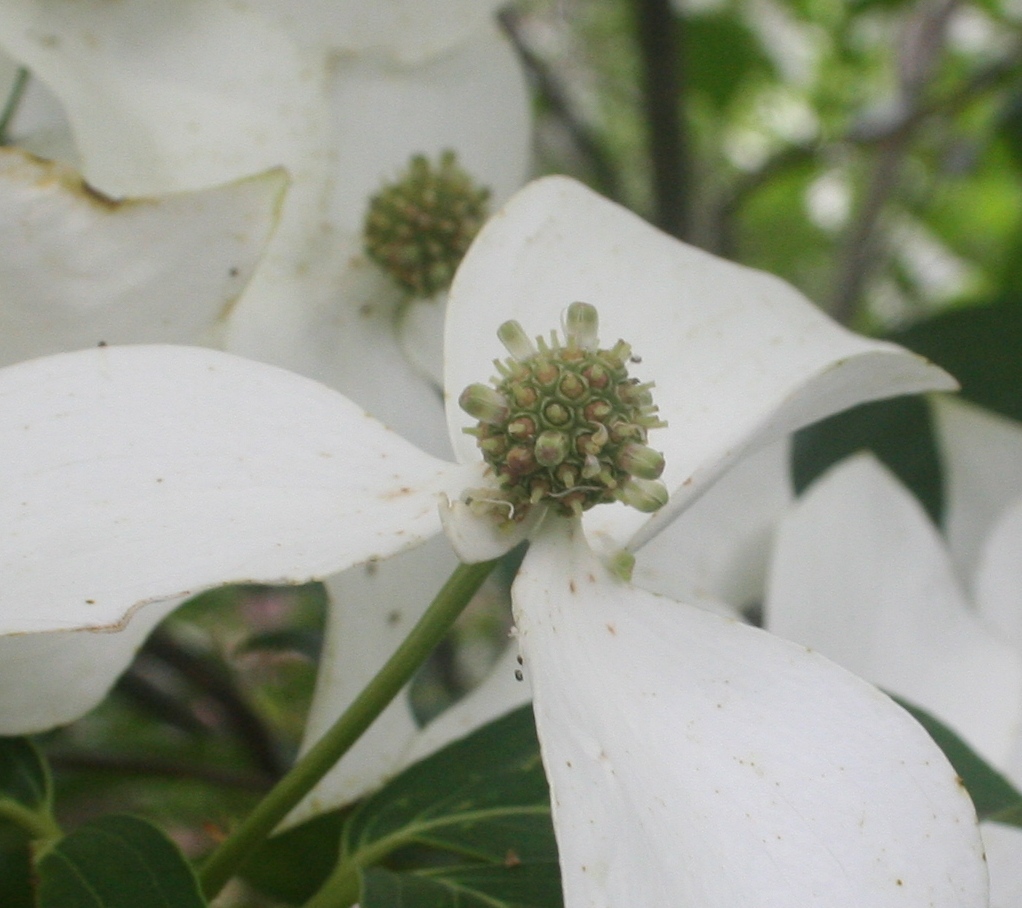
A young blossom, the flowers have not yet bloomed. The showy bracts are brushed with wine.
An older blossom whose flowers have finished blooming. The bracts are faded to white and are drying and falling away from the developing fruit.

The true flowers of the kousa dogwood are pretty innocuous and bloom in a tight cluster.  They are surrounded by four colored bracts and give the illusion of a four petaled flower with a knobby green center.

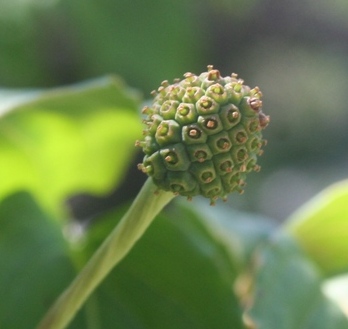
Once the flowers have been pollinated, the flower head develops into a fruit.

Unripe, the green fruit stands out from the flower on a long, sturdy stem.

Over the summer it slowly swells as seeds form. In the fall, it ripens into a mature, seed filled fruit. The individual lobes increase in size and turn from green to a deep, dusky red.

When fully ripe, the fruit resembles large raspberries but the similarity stops there.

The fruit is edible and sweet and different varieties have different flavor palettes.

It provides a tasty winter food for birds and squirrels and a few humans and dogs as well.

We'll explore the flavor and texture of this fruit more in the fall but at least one member of our fur family is too impatient for the fruit to ripen. 

Katie nips a green fruit off one of the lower branches.
Our youngest Cavalier King Charles Spaniel, Katie, has developed a fondness for the green fruits.

She loves to climb the rocks behind the pond to sneak a tasty morsel whenever she can.


Chewing the green fruit right off the tree.
After she ate the fruit off one branch, she moved on to another.


 .

Wednesday, May 11, 2011

Red Dogwood

Red flowering dogwoods are not as familiar as their pink and white cousins but for those of us who are fortunate to have one, they are definitely a treat for the eye in the early spring garden.

One of the more popular and frequently seen varieties, Cornus florida "Cherokee Chief," came to us by accident a few years ago, tagged as a pink dogwood and marked down to a ridiculously low price at the end of the gardening season.

I had been wanting a pink dogwood ever since the one my husband gave me when we were first engaged had an unfortunate confrontation with a landscaper's tractor and lost. After several gardening seasons spent fruitlessly trying to locate "the perfect tree", I'd given up hope of finding  a dogwood tree at a local nursery that was mature, affordable, and branched low on the trunk the way my original tree had. That low spreading conformation worked well for the spot in which the original dogwood had stood and we ultimately replaced it with a tree of a different variety that had that shape and habitus. Still, I missed my pink dogwood and I couldn't believe my good luck to have found a mature tree at an affordable price.

The place my original pink dogwood had graced was now occupied by a sand cherry so we had to find a new home for the pink dogwood. We planted the tree in our flowering tree and shrub grove and positioned it behind the waterfall of our koi pond. It was the best location for the tree, and the only place in the tree grove that it could reasonably fit. It has proven to be a perfect location artistically as well as logistically.

The following spring, we were amazed when we looked out one morning and saw the tree in bloom - a rich, beautiful carmine against dove gray bark, the color was spectacular. That first year, an azalea planted next to the waterfall, directly in front of it, was blooming at the same time and the effect was right out of a Thomas Kinkade painting.

As the garden has matured and both the dogwood and the Japanese maple behind the waterfall have grown, the architecture of the garden has evolved. The red dogwood blooms weeks before the white dogwoods, and except for that first spring, at least a couple of weeks before the azaleas. But viewed against the Japanese maple, it's a dramatic combination and one I could not have imagined when we placed it in that location.

I still don't have a pink dogwood but I love the red "Chief". The blossoms are stunning, 3" - 4" in width, and long lasting. The tree is equally beautiful in fall when the leaves turn a brilliant scarlet. The flowers give way to red berries and the few that remain after the birds have their fill provide winter interest and color. It's very happy in its shaded, woodland area. In the tree grove, it stands next to a dry river bed which assures good drainage.

The planting guides say that these trees grow fairly slowly but that has certainly not been our experience. Then again, I guess it depends on your definition of "slow". It has grown about a foot in height each year.

As with the poinsettia, the blossoms are not actually blossoms at all. The deeply colored "petals" are bracts or modified leaves. The "real" blossoms are the tiny bud heads clustered in the middle of the bracts.  Regardless, it's a colorful addition to our spring garden and although I don't have a pink dogwood, I love the Chief!